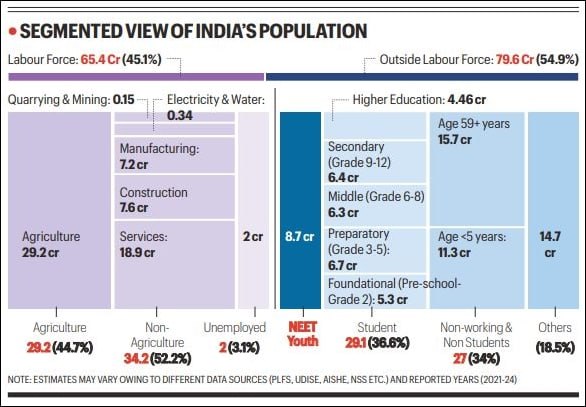
What does NITI Aayog's assessment find?
Severe education–employment mismatch
More than 90% of graduates work in occupations unrelated to their field of study.
Generic degrees such as BA, B.Sc and B.Com often do not provide specialised, job-ready skills.
A degree is therefore increasingly becoming a credential rather than a guarantee of employability.
Curriculum–industry disconnect.
Many higher-education institutions continue to use outdated curricula.
Courses do not adequately reflect emerging industry requirements.
There is insufficient integration of practical training, technology and workplace exposure.
Skill mismatch
India faces both:
Unemployment/underemployment of educated youth, and
Skill shortages faced by industries.
This indicates a structural mismatch between what the education system produces and what the labour market demands.
Need for sector-specific education.
NITI Aayog advocates greater focus on specialised, job-linked programmes in emerging sectors such as green industries, Electric vehicles, advanced manufacturing, and other technology-intensive sectors
Apprenticeship-based learning
Greater emphasis on apprenticeships and industry exposure can help students acquire practical skills while simultaneously improving their understanding of workplace requirements.
Why is this important?
The issue is not simply “lack of jobs”. It is also a problem of “lack of appropriate skills for available jobs.”
India's demographic advantage can become a liability if educated young people possess degrees but lack market-relevant skills.
Challenges
Outdated curricula and slow university reform.
Weak collaboration between industry and educational institutions.
Low participation in apprenticeships compared with India's workforce requirements.
Social preference for conventional academic degrees over vocational education.
Uneven quality of higher education across States and institutions.
Rapid technological change makes skill requirements constantly evolving.
MSMEs may lack the resources to provide structured apprenticeship programmes.
Short-term skilling programmes may produce certificates without genuine employability.
Way Forward
Make curricula industry-linked
Universities should regularly update courses in consultation with employers, professional bodies and sector skill councils.
Expand apprenticeships
Move from classroom-centric education towards a learn-and-work model, combining academic knowledge with workplace experience.
Strengthen industry–academia partnerships.
Industry should participate in: Curriculum design, Faculty training, Internships, Apprenticeships, Certification, Campus recruitment.
Improve vocational education
Vocational education should be treated as a mainstream career pathway, not as an inferior alternative to university education.
Focus on outcomes rather than enrolment
Education policy should measure: employment → earnings → job relevance → career progression, rather than merely counting degrees and enrolments.
Conclusion
The assessment provided by NITI Aayog indicates that it is not enough for India to produce more graduates but more employable graduates. The strategy lies in shifting from an education system driven by degrees to an ecosystem of skills and employment. This will help in turning India’s large pool of youth labour force into a demographic dividend rather than a demographic burden.