Background
The Armed Forces (Special Powers) Act, 1958 was enacted to address insurgency and serious internal-security challenges in the Naga Hills and Assam.
Under Section 3, an area can be declared a “disturbed area” when the situation is considered sufficiently disturbed to require the use of armed forces in aid of civil power.
Who can declare an area disturbed?
Both:
Central Government, and
State Government
can make a declaration under Section 3.
Once an area is notified as disturbed, armed forces deployed there receive special powers under AFSPA.
Key powers under AFSPA
Under Section 4, authorised personnel can, subject to the statutory conditions:
Use force, including lethal force, against persons acting in contravention of laws/orders prohibiting the assembly of persons or carrying of weapons.
Arrest without warrant.
Enter and search premises without warrant to make arrests or recover persons/property in specified circumstances.
Destroy arms dumps, fortified positions or shelters used by armed groups in the circumstances specified by the Act.
Legal protection
Section 6 provides that no prosecution, suit or other legal proceeding against a person acting under AFSPA can be instituted without the previous sanction of the Central Government.
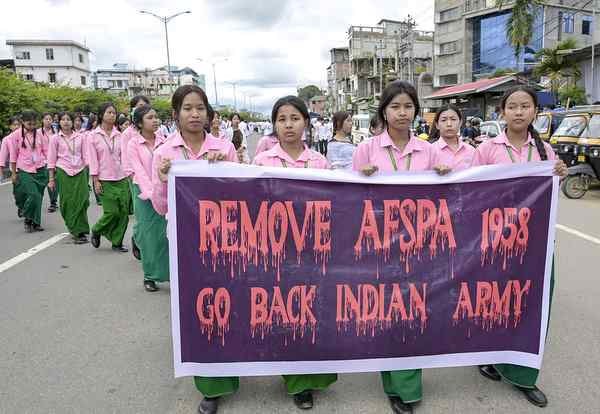
This provision, along with the wide operational powers under Section 4, is one of the major sources of controversy surrounding AFSPA.
AFSPA in Manipur: Evolution
AFSPA had been gradually withdrawn from several parts of Manipur before the 2023 ethnic conflict.
2004: Withdrawn from the Imphal Municipal Area.
2022–April 2023: Withdrawn progressively from police-station areas in the Manipur Valley.
May 2023: Ethnic violence significantly altered the security situation.
November 2024: MHA reimposed AFSPA in six police-station areas across five districts.
The 2024 decision was notable because the Centre issued the notification, while the Manipur Cabinet subsequently recommended its review and withdrawal.
The latest extension therefore represents a reversal of the earlier trend of progressively reducing AFSPA's geographical footprint.
Challenges
Human rights concerns
The extensive powers to use force, arrest and search have generated concerns regarding:
Excessive use of force
Arbitrary arrest and detention
Alleged custodial abuses
Accountability for alleged violations
Accountability deficit
The requirement of prior Central sanction for prosecution can make criminal accountability difficult and has therefore remained controversial.
Civil–military relationship
AFSPA places the armed forces in a law-and-order environment ordinarily handled by civilian police, raising questions regarding the appropriate balance between national security and civilian administration.
Political alienation
Critics argue that prolonged military presence can contribute to alienation among local populations and potentially complicate efforts to resolve insurgencies through political dialogue.
Complex security environment
In regions such as Nagaland and Manipur, security challenges are intertwined with ethnic tensions, insurgency, political negotiations and difficult terrain, making a purely military solution inadequate.
Way Forward
Regular review
Disturbed-area declarations should be subjected to objective, periodic security assessments rather than becoming open-ended arrangements.
Strengthen civilian policing
Improve:
State police capacity
Intelligence gathering
Investigation
Forensic capabilities
Border management
This can gradually reduce dependence on extraordinary military powers.
Accountability mechanisms
Maintain effective mechanisms for investigating allegations of abuse while ensuring that genuine security personnel acting lawfully are protected.
Political dialogue
In Nagaland and other insurgency-affected areas, sustained dialogue with relevant stakeholders should accompany security measures.
Development and governance
Address underlying drivers of instability through:
Infrastructure
Employment
Better public services
Political participation
Inclusive governance
Trust-building
Regular engagement among the Centre, State governments, armed forces and local communities can help balance security requirements with civil liberties.
Conclusion
AFSPA remains an extraordinary security measure for areas facing serious insurgency and internal-security challenges. However, its continuation must balance national security with human rights and accountability. Regular review, stronger civilian policing, political dialogue, development and transparent accountability mechanisms can help reduce dependence on exceptional powers while strengthening public trust.