Background
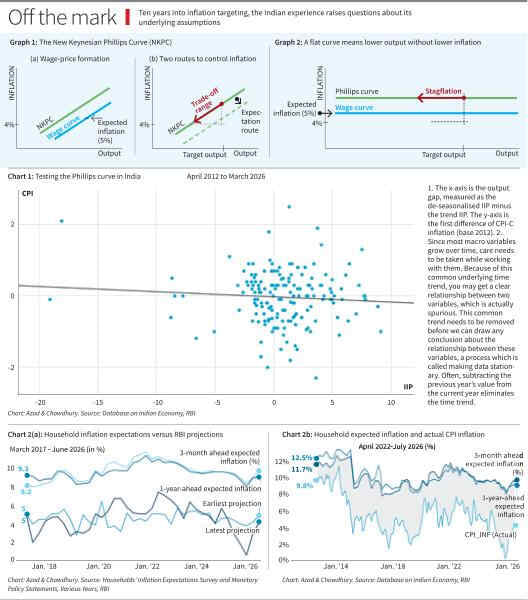
India adopted a formal flexible inflation-targeting framework in 2016. The RBI’s mandate is to keep CPI inflation at 4%, with a tolerance band of 2%–6%.
Inflation targeting is expected to work through two major channels:
Demand management
When inflation rises, the RBI increases the repo rate.
Bank lending rates rise.
Borrowing and consumption decline.
Businesses postpone investment.
Aggregate demand falls, reducing inflationary pressure.
Managing inflation expectations
If households and firms believe inflation will remain low, they are less likely to demand higher wages or raise prices.
Therefore, credible RBI policy should theoretically anchor inflation expectations around the target.
Features of Inflation Targeting in India
Explicit target: RBI aims to maintain CPI inflation at 4%, with a tolerance band of 2%–6%.
Flexible framework: Price stability is the primary objective, while supporting growth is also considered.
Repo rate as the main tool: RBI changes policy rates to influence borrowing, consumption, investment and aggregate demand.
Expectation management: RBI seeks to anchor household and business inflation expectations around the 4% target.
Forward-looking approach: Monetary policy considers expected future inflation rather than only current inflation.
Accountability: Persistent deviation from the target requires the RBI to explain the reasons and corrective measures.
Institutional mechanism: Decisions are taken by the Monetary Policy Committee (MPC) rather than the RBI Governor alone.
Data-driven framework: Policy decisions use inflation, growth, employment, demand conditions and other macroeconomic indicators.
Fixed target period: The inflation target is reviewed periodically by the Government of India and RBI.
Inflation Targeting in India
Explicit target: CPI inflation target of 4%, with a tolerance band of 2%–6%.
Flexible inflation targeting: Price stability is the primary objective while keeping growth in mind.
Monetary Policy Committee (MPC): Interest-rate decisions are taken collectively by the MPC.
Repo rate mechanism: RBI influences demand through changes in policy interest rates.
Expectation management: RBI seeks to anchor household and business expectations around the inflation target.
Accountability: RBI must explain persistent deviations from the prescribed inflation target.
Forward-looking: Policy decisions are based on expected inflation and evolving economic conditions.
Challenges
Flat Phillips Curve: Higher interest rates may reduce output and employment without significantly lowering inflation.
Weak wage bargaining: Large informal employment limits the conventional wage–inflation relationship.
Unanchored expectations: Household inflation expectations often remain above RBI projections.
Supply-side shocks: Food, fuel, and weather-related shocks are difficult to control through monetary policy.
Growth–inflation trade-off: Tight monetary policy can hurt investment, consumption and employment.
Model–reality mismatch: Conventional inflation-targeting assumptions may not fully suit India's structural conditions.
Way Forward
Combine monetary policy with supply-side measures to tackle food and fuel inflation.
Strengthen agricultural productivity, storage, logistics and supply chains.
Improve RBI communication to better anchor inflation expectations.
Enhance coordination between RBI, government and fiscal authorities.
Give greater attention to employment and growth costs while controlling inflation.
Develop India-specific macroeconomic models that account for the informal sector and supply constraints.
Conclusion
Inflation targeting has strengthened India's price-stability framework, but its effectiveness is constrained by structural and supply-side factors. India therefore needs a balanced and context-specific approach, combining credible monetary policy with supply-side reforms while safeguarding growth and employment.


