Background
The IBC, 2016 was introduced to create a time-bound framework for insolvency resolution and improve the recovery of stressed assets.
A haircut refers to the reduction in the amount ultimately recovered by a creditor compared with its admitted claim. The term itself is not defined in the IBC.
The Code gives primacy to a creditor-approved resolution plan: once the prescribed majority approves a plan and the tribunal sanctions it, dissenting creditors are generally bound by the outcome.
In the Chandra case, the liability largely arose from personal guarantees and indemnities provided for borrowings of companies associated with the Essel Group.
The case proceeded through personal insolvency proceedings against a personal guarantor, rather than insolvency proceedings against a corporate debtor.
What is a “haircut” under the Insolvency and Bankruptcy Code, 2016?
The term is not defined in the Code: The IBC nowhere defines a haircut. Banking practice uses the word for the percentage reduction in the value of an asset pledged as collateral, applied to protect the lender against loss.
What the Code was enacted to do: The IBC was enacted in 2016 to rescue companies under financial stress or heavy debt through resolution and repayment to creditors.
A creditor majority binds the minority: Once the required majority of creditors approves a repayment plan and the tribunal sanctions it, a dissenting creditor cannot walk away and demand a separate settlement.
Features
Extremely high haircut
Creditors are to receive ₹6.5 crore against admitted claims of ₹22,006.57 crore.
This represents a 99.97% reduction in admitted claims.
It is therefore being viewed as an exceptional case within India's insolvency regime.
IBC's recovery record
Between 2021-22 and 2025-26:
1,077 cases were resolved.
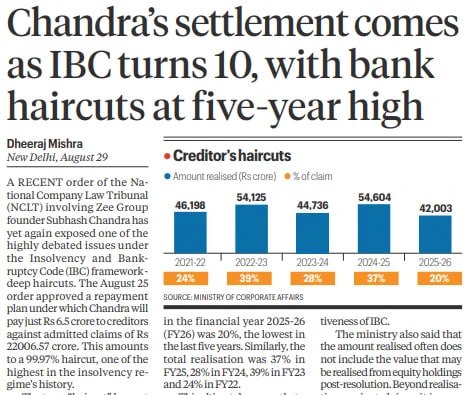
Creditors realised around ₹2.47 lakh crore.
Average recovery against admitted claims was approximately 29%.
Recovery fell to around 20% in 2025-26, the lowest among the five years cited.
Resolution vs recovery
There are two competing approaches:
Government's position:
The primary objective of the IBC is resolution, not recovery.
Admitted claims may not represent the actual economic value of the underlying assets.
Claims may include accumulated interest, NPAs and overlapping guarantees.
A successful resolution can preserve the going-concern value of a business.
Banks' position:
Very low recoveries indicate weaknesses in the insolvency process.
Stressed assets may not be receiving appropriate valuations.
Banks want better valuation, greater transparency and inclusion of all assets.
SBI has argued for greater emphasis on enterprise value rather than merely liquidation value.
Dispute over voting
23 creditors participated in voting.
The plan received 80.814% approval.
Banks opposing the plan represented only 19.186% of the votes.
Banks allege that entities accounting for 61.78% of votes were associated with or related to the debtor.
The central issue is therefore whether these votes were legally eligible to participate.
Why has the Chandra order revived the haircut debate?
The size of the write-down: The order of 25 August approved payment of Rs 6.5 crore to creditors, plus Rs 25 lakh towards the costs of the process.
The liability arises from personal guarantees: Much of the admitted claim relates to personal guarantees and indemnities given for borrowings by companies associated with the Essel Group.
The route is personal insolvency: The proceedings ran against the individual promoter as a personal guarantor rather than against a corporate debtor.
Lenders are weighing a challenge: Banks are considering an appeal against the approval before the NCLAT.
Challenges
Prolonged resolution delays – The average resolution period reached around 744 days in FY 2025-26, far above the statutory timeline, leading to erosion of enterprise value.
High haircuts and weak recovery – Recovery fell to 23% of admitted claims in FY 2025-26, implying substantial creditor haircuts.
Liquidation over resolution – Liquidation continues to be a major outcome, while successful resolution generally produces much higher recovery than liquidation. ICRA estimates about 31% recovery through successful resolution versus only 4% through liquidation.
Valuation concerns – Inadequate or liquidation-oriented valuation may undervalue viable businesses and encourage excessive haircuts.
Institutional capacity constraints – Shortage of manpower and capacity at NCLT benches contributes to case backlogs and delays.
Creditor-voting concerns – The Subhash Chandra case raises questions about the eligibility of related parties to vote and the transparency of the Committee of Creditors (CoC) process.
Incomplete personal insolvency framework – The framework for individuals and partnership firms remains incomplete, with the operational regime largely focused on personal guarantors to corporate debtors.
Way Forward
Ensure strict time-bound resolution – Strengthen NCLT capacity, increase judicial and technical manpower, and impose stronger timelines to prevent value erosion.
Shift from liquidation value to enterprise value – For viable businesses, valuation should capture their going-concern and future earning potential, not merely distress-sale value.
Promote early resolution – Encourage pre-packaged insolvency and other restructuring mechanisms so that financially stressed firms can be rescued before their assets and business value deteriorate.
Improve valuation transparency – Strengthen independent valuation, mandate greater disclosure of valuation methodologies and scrutinise significant deviations between fair value, enterprise value and resolution offers.
Make creditor voting more transparent – Strengthen disclosure and verification of related-party relationships so that only genuinely independent creditors influence the CoC's commercial decision.
Prioritise resolution over liquidation – Since successful resolution generates substantially higher recovery than liquidation, the system should incentivise going-concern revival wherever economically viable.
Complete the personal insolvency framework – Operationalise the remaining provisions relating to individuals and partnership firms to create a comprehensive insolvency architecture.
Measure IBC through multiple indicators – Success should not be judged only by the percentage recovered against admitted claims. It should also consider speed of resolution, enterprise value preserved, employment maintained, liquidation avoided, and credit discipline created.
Conclusion
The Subhash Chandra case makes it evident that the success of the IBC cannot be measured by the extent of the haircut or the recovery achieved against recognised claims alone. The IBC is meant to ensure prompt resolution, save viable businesses, and maintain credit discipline. As such, India requires an approach that involves a combination of quick resolution and valuation, effective creditor management, and better recoveries. This will make sure that the “resolution process does not turn into a tool for value destruction, while the recovery process does not come at the expense of viable businesses.”


