Background
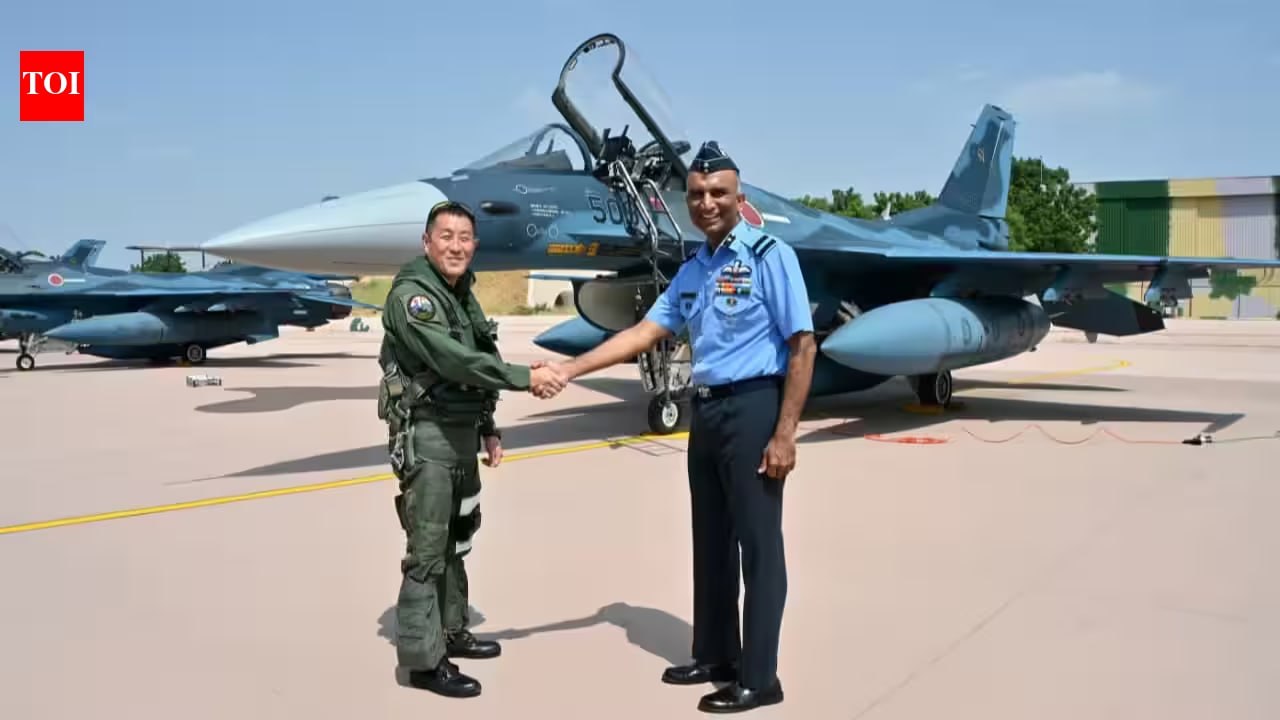
Veer Guardian is a bilateral India-Japan air exercise.
It provides a platform for both air forces to train together and understand each other's operational procedures, tactics and capabilities.
The exercise forms part of the expanding India-Japan defence and strategic partnership.
The participation of Japan's F-2A alongside India's Su-30MKI, Rafale and LCA Tejas enabled both sides to undertake realistic joint air-combat training.
Features
Participants: IAF and JASDF
Nature: Bilateral air exercise
Venue: Air Force Station Jodhpur, Rajasthan
Duration: 14 days
Indian aircraft: Su-30MKI, Rafale and LCA Tejas
Japanese aircraft: F-2A
Major training areas:
Within Visual Range (WVR) combat
Coordinated multi-aircraft missions
Operational coordination
Interoperability
Senior leadership: General Takehiro Morita, Chief of Staff, JASDF, and Air Chief Marshal AP Singh, Chief of the Air Staff, visited the exercise.
Both officials also flew the indigenous LCA Tejas.
Strategic Significance
Defence Cooperation: Strengthens the defence partnership between India and Japan.
Interoperability: Helps both air forces develop the ability to operate effectively alongside each other.
Operational Learning: Provides exposure to different operational procedures, tactics and capabilities.
Maintenance Cooperation: Interaction between technical personnel facilitates exchange of knowledge regarding maintenance practices.
Indigenous Capability: Participation of LCA Tejas provides an international operational platform for India's indigenous fighter aircraft.
Strategic Partnership: Contributes to the broader India-Japan strategic relationship in the Indo-Pacific.
Challenges
Different operational doctrines: The two air forces may follow different procedures and tactical approaches.
Technological differences: Aircraft, communication systems and support infrastructure are not identical.
Interoperability limitations: Effective joint operations require compatible communication and information-sharing mechanisms.
Complexity of modern air warfare: Coordinating multiple aircraft in a contested environment requires continuous training.
Sustained engagement: Interoperability requires regular exercises rather than one-time interaction.
Way Forward
Conduct regular and increasingly complex air exercises.
Expand cooperation in air-domain awareness and information sharing.
Increase joint training in mission planning and multi-aircraft operations.
Strengthen technical, maintenance and aerospace-safety exchanges.
Promote greater interaction between personnel and operational institutions of both air forces.
Continue integrating indigenous platforms such as LCA Tejas into international exercises.
Conclusion
Exercise Veer Guardian 2026 showcases the emerging operational element of India-Japan defence cooperation. The focus of Exercise Veer Guardian 2026 on WVR engagement, mission coordination, technical interactions and interoperability can help in fostering better understanding and coordination between the IAF and JASDF.