Background
The MQ-9B Sea Guardian is a long-endurance remotely piloted aircraft designed particularly for maritime surveillance.
It belongs to the High-Altitude Long-Endurance (HALE) category, allowing it to remain airborne for extended periods and monitor large areas.
For India, maritime surveillance is particularly important because of its extensive coastline, island territories and strategic location in the Indian Ocean Region (IOR).
The Navy requires persistent surveillance to track shipping activity, naval movements and other developments across the maritime domain.
MQ-9B Sea Guardian
What it is: A high-altitude long-endurance (HALE) remotely piloted aircraft system (RPAS), the maritime variant of the MQ-9B family built by General Atomics Aeronautical Systems Inc.
What it carries: Advanced systems, state-of-the-art sensors and sophisticated payloads for maritime surveillance.
Its primary role: It provides persistent intelligence, surveillance and reconnaissance coverage over vast areas of the maritime domain.
Its secondary role: Beyond surveillance, the MQ-9B can carry out precision strikes on strategic targets in mountains and in the maritime domain during long endurance missions.
Why persistence matters: Long endurance allows a single aircraft to hold station over a search area for a full day rather than making short sorties.
Its strategic value for India: It strengthens India’s ability to monitor and respond to developments across the Indian Ocean Region.
What is a high altitude long endurance remotely piloted aircraft system?
What it is: An unmanned aircraft flown by an operator from a ground control station, designed to cruise at high altitude and to stay airborne for very long periods without refuelling.
Why the category matters: High altitude gives a wide sensor horizon, and long endurance converts that into continuous coverage rather than snapshots.
What is maritime domain awareness?
What it is: The effective understanding of any activity in the maritime environment that could affect security, safety, the economy or the marine environment.
How it is built: It combines radar, satellite, coastal surveillance, automatic identification system data and airborne sensors into a single recognised maritime picture.
What does the new lease contain?
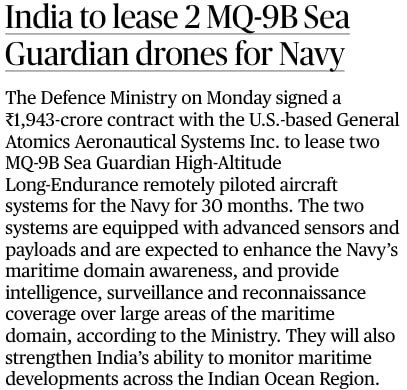
The contracting parties: The Ministry of Defence and General Atomics Aeronautical Systems Inc., a United States defence manufacturer.
The value: Rs 1,943 crore.
The quantity: Two MQ-9B Sea Guardian HALE RPAS.
The duration: 30 months.
The signing: The contract was signed in the presence of the Additional Secretary and Director General (Acquisition), Department of Defence.
The stated capability effect: The systems will significantly enhance the Indian Navy’s maritime domain awareness capabilities.
The approval trail: The Ministry of Defence approved the leasing of HALE RPAS for the Navy in December of the previous year.
Configuration: The new aircraft will have almost the same configuration as the 31 MQ-9Bs being procured, unlike the existing leased systems.
Strategic Significance
Enhanced Maritime Domain Awareness
The Sea Guardians will enable the Navy to obtain a persistent picture of activities over large maritime areas.
Wide-area surveillance
Their long endurance makes them suitable for monitoring extensive stretches of the Indian Ocean without requiring frequent replacement by another aircraft.
Strengthening ISR capability
The advanced sensors and payloads will improve India's ability to collect, monitor and analyse maritime intelligence.
Greater Indian Ocean surveillance
The system can strengthen India's ability to monitor developments across a strategically important region where increasing naval activity makes continuous surveillance important.
Leasing as an operational solution
A 30-month lease allows the Navy to obtain an immediate operational capability without necessarily waiting for a longer acquisition cycle.
Challenges
Dependence on foreign-origin platforms can create concerns regarding long-term technological and logistical dependence.
Sustaining advanced unmanned systems requires specialised maintenance, training and infrastructure.
Persistent surveillance generates large volumes of data, requiring strong data-processing and intelligence capabilities.
Operating unmanned aircraft over extensive maritime areas requires robust communications, command-and-control and satellite connectivity.
Leasing provides rapid capability enhancement but may not by itself constitute a long-term indigenous solution.
Way Forward
Develop greater indigenous HALE/UAV capabilities under the Atmanirbhar Bharat framework.
Strengthen India's maritime surveillance architecture by integrating UAVs with satellites, maritime patrol aircraft, warships and coastal surveillance systems.
Improve AI-enabled data analysis for faster identification of unusual maritime activity.
Expand indigenous capabilities in sensors, propulsion, communication links and autonomous systems.
Use the leased platforms to build operational experience, doctrine and specialised human resources for future indigenous systems.
Conclusion
The lease of two MQ-9B Sea Guardians is a quick way of boosting India’s maritime surveillance and ISR abilities. Most importantly, it allows India to achieve its goal of increasing situational awareness in the Indian Ocean Region. Nevertheless, the aim should be to ensure that such a boost in capability leads to the development of indigenous unmanned maritime surveillance systems.