Background
Amicus curiae: A senior lawyer appointed by the court to assist it impartially. In this case, the amicus collects data from High Courts, examines compliance with Supreme Court directions and submits periodic reports.
Special courts: Courts constituted specifically to deal with a particular category of cases.
Designated courts: Existing Sessions or Magistrate courts identified to give priority to cases involving legislators while continuing their ordinary judicial work.
In 2017, the Supreme Court directed the creation of 12 special courts in 10 States/UTs.
In 2018, it directed that designated Sessions and Magistrate courts be identified in every district.
In 2023, High Courts were directed to initiate suo motu proceedings for monitoring early disposal.
The matter was subsequently referred to a three-judge Bench in February 2025.
Features
Large and persistent pendency
4,192 cases pending trial.
519 pending for more than 10 years.
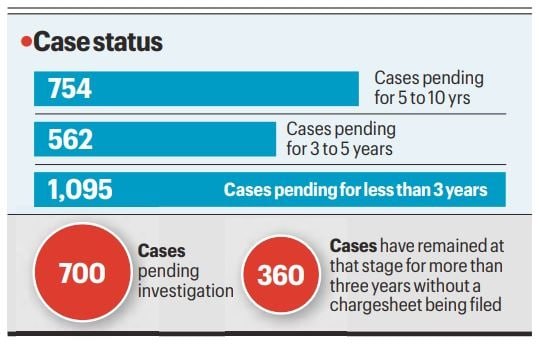
754 pending for 5–10 years.
562 pending for 3–5 years.
1,095 pending for less than 3 years.
Investigation itself is delayed
700 cases remain under investigation.
360 have remained at the investigation stage for more than three years without a chargesheet.
State-wise concentration
The highest number of pending cases is reported in:
Uttar Pradesh – 1,171
Kerala – 543
Bihar – 373
Maharashtra – 364
Odisha – 330
Criminal cases involving sitting legislators
251 of 543 Lok Sabha MPs
75 of 233 Rajya Sabha MPs
have criminal cases against them, according to the data cited in the report.
Chief Ministers
Chief Ministers of 14 of 28 States reportedly have criminal cases pending trial.
Persistent trend
Pendency increased from 4,075 in December 2018 to 5,140 in November 2022, before declining to 4,192 in July 2026. However, it has remained above 4,000 for years.
Constitutional Significance
The issue involves several constitutional principles:
Article 14: Equality before law and equal protection of laws.
Article 21: Fair and speedy trial as part of the right to life and personal liberty.
Rule of law: Political office should not provide immunity from ordinary criminal justice.
Democratic accountability: Voters deserve timely judicial determination of serious criminal allegations against those exercising public power.
Judicial independence: Courts must be able to decide cases without political pressure or executive interference.
A crucial distinction is that pendency does not mean guilt. Criminal cases remain allegations until conviction after a fair trial.
Why is Pendency Persisting?
Priority without additional capacity
Designated courts continue to handle their normal workload. Merely marking a case as “priority” does not create additional judges, courtrooms or prosecutors.
Repeated adjournments
Frequent adjournments interrupt the continuity of trials and allow cases to remain pending for years.
Non-appearance of accused
If an accused legislator repeatedly fails to appear, proceedings can be delayed.
Witness-related delays
Witnesses may not appear on scheduled dates, and cases involving influential accused persons can also raise concerns about witness intimidation or hostility.
Weak monitoring
The Supreme Court's 2023 direction for suo motu monitoring by High Courts has reportedly not been implemented uniformly.
Investigation-stage bottleneck
A speedy trial is impossible if the investigation itself remains incomplete. The 360 cases pending investigation for over three years demonstrate that the problem begins before trial.
Data inconsistencies
The amicus report and High Court websites show different totals, and State-wise data have different cut-off dates. The Allahabad High Court did not submit a report, requiring its figure to be taken from its website.
Challenges
Lack of judicial infrastructure
The fundamental problem is capacity. Priority cases cannot be processed rapidly when courts lack additional judges and supporting staff.
Executive influence over prosecution
Public prosecutors are appointed through State mechanisms, creating a potential institutional conflict where the accused is himself a powerful political executive.
Witness protection
Political influence can make witnesses vulnerable to intimidation, inducement or hostility. Effective implementation of the Witness Protection Scheme, 2018 remains important.
Investigation delays
The criminal justice chain is sequential:
Investigation → Chargesheet → Framing of charges → Evidence → Arguments → Judgment
Delay at any stage postpones final adjudication.
Withdrawal of criminal cases
The possibility of withdrawal of prosecution, subject to judicial scrutiny under the applicable criminal procedure, can complicate efforts to ensure consistent prosecution of politically connected accused.
Equality versus prioritisation
Giving legislators priority raises an important constitutional question: Should one category of accused receive faster trials when ordinary undertrials themselves face severe delays?
The justification for priority is not that legislators are more important citizens. Rather, their continued holding of public office and the possibility of conviction-triggered disqualification create a public-interest dimension to timely adjudication.
Speed versus quality
Expediting trials must not mean sacrificing the quality of investigation, evidence collection or judicial scrutiny. Fast justice must remain fair justice.
Way Forward
Day-to-day hearings: Cases pending for more than three years should ordinarily receive continuous hearings.
Strict attendance: Repeated non-appearance should attract appropriate coercive measures in accordance with law.
Nodal prosecution officers: Dedicated officers should coordinate witness attendance and prosecution requirements.
Time-bound investigation: Investigations should be completed within prescribed timelines, with accountability for unexplained delays.
One-year trial target: Trials should preferably conclude within one year after framing of charges, subject to judicially justified exceptions.
Monthly High Court monitoring: Cases pending for more than three years should be reviewed regularly.
Real-time data: Courts should maintain publicly accessible, standardised and regularly updated databases.
Micro-monitoring: Individual long-pending cases should be tracked rather than relying only on aggregate statistics.
Additional resources: Most importantly, priority should be backed by additional judges, prosecutors, court staff and infrastructure.
Conclusion
The 22nd amicus report proves that India’s challenge is not merely the lack of directions from the Supreme Court, but that of capacity. Even with special courts in 2017, designated courts in 2018, and monitoring directions in 2023, pendency of cases has remained more than 4,000. The remedy, thus, would consist in changing from “priority on paper” to “capacity in practice” – provision of additional judicial capacity, independent and accountable prosecution, proper witness protection, strict case management, and effective monitoring. The final aim should be none other than “justice for all” rather than giving priority to the politicians and delaying their cases indefinitely.