Background
At Independence, India faced widespread illiteracy, particularly among women, rural communities and socio-economically disadvantaged groups.
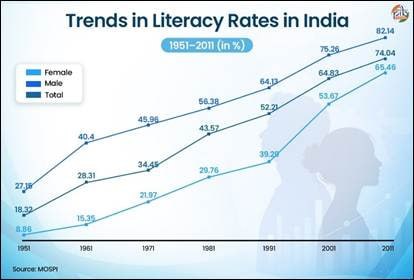
India’s literacy rate increased from 18.32% in 1951 to 74.04% in 2011.
Female literacy witnessed a particularly significant improvement, rising from 8.86% in 1951 to 65.46% in 2011.
The National Education Policy (NEP) 2020 places strong emphasis on:
Foundational Literacy and Numeracy (FLN)
Adult education and lifelong learning
Universal access to quality education
Reduction of educational inequalities.
The government considers 95% literacy in a State/UT as equivalent to full literacy.
India’s literacy agenda is closely linked with SDG 4, which seeks to ensure inclusive and equitable quality education and promote lifelong learning opportunities for all.
Features
ULLAS – Adult Literacy
ULLAS (Understanding of Lifelong Learning for All in Society), also known as the New India Literacy Programme (NILP), focuses on adults aged 15 years and above who did not receive adequate formal schooling.
It covers:
Foundational literacy and numeracy
Critical life skills
Vocational skills
Basic education
Continuing education
Lifelong learning
The programme adopts a volunteer-based and Janbhagidari approach, involving citizens as volunteers and learners.
Target: 5 crore learners during 2022–27.
NIPUN Bharat – Foundational Learning
NIPUN Bharat stands for National Initiative for Proficiency in Reading with Understanding and Numeracy.
Launched in July 2021 under Samagra Shiksha.
Focuses on children in the Foundational Stage (3–8 years).
Objective: Achieve universal foundational literacy and numeracy by 2026–27.
Emphasis is on ensuring that children acquire basic reading, writing and numeracy skills by Grade 2.
Thus, ULLAS addresses adult literacy, whereas NIPUN Bharat focuses on foundational learning among young children.
Supporting Initiatives
Other programmes complement the literacy mission:
Samagra Shiksha: Integrated scheme for school education from pre-school to Class XII.
PM SHRI: Development of more than 14,500 exemplar schools.
PM e-VIDYA: Digital, online and on-air learning initiatives.
PM POSHAN: Nutritional support through hot cooked meals for eligible schoolchildren.
Challenges
Regional disparities
Literacy levels differ considerably across States/UTs and rural-urban areas.
Gender gap
Although the female literacy rate has increased substantially, gender disparities in educational access and outcomes continue in some regions.
Quality versus mere literacy
Being able to read and write does not necessarily imply functional literacy. Learning outcomes and comprehension remain important.
Foundational learning deficit
Children may attend school but fail to acquire age-appropriate reading and numeracy skills, making NIPUN Bharat particularly important.
Adult illiteracy
Adults who missed formal schooling may face difficulties in accessing digital services, financial systems, government schemes and employment opportunities.
Digital divide
Differences in access to devices, internet connectivity and digital skills can reinforce existing educational inequalities.
Social and economic barriers
Poverty, migration, child labour, inadequate infrastructure and social norms can adversely affect educational participation and retention.
Way Forward
Shift from literacy to learning
Policy should focus not merely on literacy percentages but on measurable reading comprehension, numeracy and functional skills.
Strengthen foundational education
NIPUN Bharat should be supported through:
Better teacher training
Local-language learning material
Early childhood education
Continuous assessment
Remedial learning.
Expand adult education
ULLAS can be strengthened through community-based learning centres, volunteers, NGOs and local institutions.
Bridge the digital divide
Greater investment is required in:
Internet connectivity
Affordable devices
Digital literacy
Multilingual educational content.
Focus on disadvantaged groups
Special attention should be given to women, tribal communities, persons with disabilities, migrants and economically disadvantaged households.
Improve data-driven monitoring
Regular assessment of learning outcomes, rather than enrolment alone, should guide policy interventions.
Promote lifelong learning
Literacy should be connected with vocational skills, financial literacy, digital literacy, health awareness and employment opportunities.
Conclusion
India has made remarkable progress in the domain of literacy since its Independence, with an increase in the literacy rate from 18.32 per cent in 1951 to 74.04 per cent in 2011 and achieving 81.1 per cent, as per PLFS 2025. Nevertheless, universal literacy is more than an increase in the literacy rate. The dual strategy of ULLAS and NIPUN Bharat, facilitated by NEP 2020 and other educational programs, aims to bring about universal learning for India.