Monthly Current Affairs
July 2026 Current Affairs

The next DPI — how India can commoditise AI
India has proposed an expansion of the successful DPI concept into Artificial Intelligence through the establishment of low-cost AI computing, foundation models, and a Unified Intelligence Interface (UII). AI can become an easily available public utility through the IndiaAI Mission and contribute to innovation, technological sovereignty, and inclusive development.

When is Heavy Rainfall a Cloudburst, and When is It Not?
A cloudburst, according to the IMD, is a sudden heavy rainfall of 100 mm or more occurring within an hour in an area of 20 to 30 sq. km. Such phenomena are very common in the Himalayan region, which leads to flash floods and landslides.

Supreme Court Restricts Retrospective Environmental Clearances
The retrospective clearance (ex post facto clearance) of the project refers to the clearance provided to a project after its implementation or completion in the absence of prior Environmental Clearance (EC). According to the Supreme Court, such regularisation in a blanket manner by an Office Memorandum of the executive is unconstitutional.

BS-III Vehicles May Need Modifications for E20 Fuel: Government
E20 is a fuel consisting of 20 per cent ethanol and 80 per cent petrol; it is available through India’s Ethanol Blended Petrol programme to reduce the country’s reliance on imported crude oil, mitigate pollution, and boost renewable energy production. It can be used in BS-IV, BS-VI and E20-compatible vehicles, but older BS-III vehicles need some rubber parts replaced.

Industrial growth hits 23-month high of 7.3%
Industrial production in India increased by 7.3% in June 2026, marking the highest growth rate since August 2024. It is necessary to maintain this trend while managing the concerns surrounding the monsoon, inflation, geopolitics, and logistics.

The Rupee is No Longer Overvalued
The rupee is undervalued, making India competitive in exports and manufacturing. Yet, import prices, inflation, and other risks pose difficulties. This calls for a stable currency exchange rate, increased exports, and structural reform.

India’s Total Exports Reach Record $863.1 Billion in 2025-26
India recorded an all-time high of US$863.1 billion for its exports in fiscal year 2025-26, owing to its robust performance in merchandise exports, service exports, FTAs, and digital trade facilitation. Even when faced with obstacles such as global slowdown, protectionism, and logistics costs, India will continue to grow through exports owing to its FTAs, manufacturing, infrastructure, and MSMEs.

Public Examinations (Prevention of Unfair Means) Amendment Bill, 2026 taken up in Lok Sabha
The Public Examinations (Prevention of Unfair Means) Amendment Bill, 2026 is an improvement on the 2024 legislation that penalises leakages of papers and examination fraud with stringent measures, setting up fast-track courts, and making investigations time-bound. The bill seeks to ensure that merit is safeguarded, there is transparency, restoring public confidence, and strengthening the credibility of exams in India.

Fiscal Health Index (FHI) 2026
Fiscal Health Index (FHI) 2026 of NITI Aayog is a rating tool for evaluating the fiscal performance of 28 States for FY 2023-24 based on four criteria – quality of expenditure, revenue generation, fiscal prudence, and debt management. It helps to promote fiscal responsibility, sustainability of public finance, transparency, and cooperative federalism.
Project Kusha LR-SAM: DRDO Air Defence Test 2026
DRDO conducted the maiden flight-test of the Kusha Long-Range Surface-to-Air Missile on 23 July 2026 from APJ Abdul Kalam Island, Odisha, intercepting an electronic target. Complete UPSC analysis of Project Kusha, the M1-M2-M3 interceptor family, Mission Sudarshan Chakra and India's layered air defence.
Investment Friendliness Index 2026: Gujarat Tops
NITI Aayog's first Investment Friendliness Index scores all 28 states and 8 Union Territories on 84 indicators across 8 pillars. Gujarat leads with 56.6 out of 100, Maharashtra and Tamil Nadu follow — and no state crossed 60. Complete UPSC analysis of the methodology, rankings and reform message.
APAAR ID Explained: One Nation One Student ID
The Supreme Court in July 2026 directed the Centre and CBSE to add an opt-out option to the APAAR consent form and ruled that all student data under the scheme is governed by the DPDP Act, 2023. Complete UPSC analysis of APAAR, NEP 2020, the Academic Bank of Credits and the privacy debate.
Quad Manila 2026: Foreign Ministers Back ASEAN Centrality
The Quad foreign ministers met in Manila on 22 July 2026 on the sidelines of ASEAN-related meetings and issued a joint press release reaffirming a free and open Indo-Pacific and 'unwavering support' for ASEAN unity and centrality. Complete UPSC analysis of the outcomes, the summit question and India's Indo-Pacific strategy.
Vikram-1: India's First Private Rocket Reaches Orbit
Skyroot Aerospace's Vikram-1 lifted off from Sriharikota on 18 July 2026 and reached a 450 km low Earth orbit, making India the third country with private orbital launch capability. Complete UPSC analysis of the vehicle, Mission Aagaman payloads, ISRO and IN-SPACe support, and India's space sector reforms.
India Climate Vulnerability: 109 Very High-Risk Districts
Environment Minister Bhupender Yadav told the Lok Sabha on 27 July 2026 that national assessments over ten years have flagged 109 districts as 'very high' climate-risk and 201 as 'highly' vulnerable, with NICRA modelling projecting rainfed rice yields down 47% by 2080. Complete UPSC analysis of NAPCC, NICRA, adaptation finance and the Western Ghats ESA deadlock.
Sarnath UNESCO World Heritage Site: India's 45th
The Ancient Buddhist Site of Sarnath was inscribed on the UNESCO World Heritage List on 25 July 2026 at the 48th session of the World Heritage Committee in Busan, becoming India's 45th site and Uttar Pradesh's fourth. Complete UPSC analysis of the criteria, the 1972 Convention, Ashokan art and Buddhist history.
Right to Protest in India: Police Permission and Law
The police action against the 20 July 2026 march to Parliament has revived the oldest question in Indian public law: can a fundamental right require a permission slip? Complete UPSC analysis of Article 19(1)(b), Section 163 BNSS, the Police Act 1861 and the landmark judgments from Himat Lal to Shaheen Bagh.
RBI Monetary Policy 2026: Repo Rate Held at 5.25%
The RBI's Monetary Policy Committee held the repo rate at 5.25% with a unanimous 6-0 vote in June 2026 and retained the neutral stance. FY27 CPI inflation is projected at 5.1% and GDP growth at 6.6%. Complete UPSC analysis of the framework, transmission, the West Asia oil shock and the monsoon risk.
Section 301 Forced Labour Tariffs: India Gets 10%
The US has imposed a 10% Section 301 tariff on Indian goods from 24 July 2026 under a forced-labour action covering 60 economies. India escaped the 12.5% slab after amending its Foreign Trade Policy. Complete UPSC analysis of the legal basis, WTO implications and India's response.

NITI Aayog Releases Investment Friendliness Index Report
The Investment Friendliness Index (IFI) by NITI Aayog is an index that measures the states and UTs on their investment-friendliness with 84 parameters across eight domains. It includes 28 states and 8 UTs and serves the purpose of promoting competitive and cooperative federalism, bringing about reforms, improving investment, and implementing the vision of Viksit Bharat @2047.

Fast-Track Courts in India: Meaning, Features & Importance
The Fast-Track Courts (FTCs) help speed up cases that need to be tried, but these courts do not have their own special legislation. They depend on having sufficient judges, facilities, investigations, and forensic aid for effective operations. Even though they have helped increase the disposal rate, vacancies in judges and poor investigations pose serious problems.

Is Yashwant Varma Still a Judge? Latest Status Explained
Judicial independence and accountability were put into question when Justice Yashwant Varma resigned from his position in April 2026 following the misconduct allegation. Resignation terminates the process of removal which means that constitutional and statutory changes have to be made in order for Parliament to continue overseeing judges and maintain public trust in the judiciary.

Why inflation is rising in India? Causes & Impact Explained
In India, the WPI inflation rate has shot up to 9.87% in June 2026 due to factors including a rise in prices of fuels, manufacturing costs, and a weak monsoon causing food inflation. This particular event has brought out the importance of implementing supply-side measures, climate-friendly farming techniques, fuel taxation policy, energy security, and macroeconomic measures.

CDSCO Approves India's First Dengue Vaccine
India is the first country to give approval for the world’s first dengue vaccine called QDENGA (TAK-003). It is a two-shot vaccine that can help protect against all four dengue serotypes without screening. Even though it will enhance the prevention of dengue disease, it will only succeed if it is made accessible to all.

India's F&O Boom Needs Adequate Protections
The futures and options market in India has shown remarkable growth to become one of the biggest derivative markets in the world. But with increasing participation from retail customers, especially new and inexperienced traders, there have been considerable financial losses, indebtedness, and suicide cases reported.

Revised Index of Core Industries (ICI) Series (Base Year 2022–23)
The Index of Core Industries (ICI) based on the base year 2022-23 will be rolled out by the Office of Economic Adviser (DPIIT) on July 20, 2026, in place of the 2011-12 series. The Index of Core Industries will include Iron Ore as the ninth core industry through this revision.

India’s First Hydrogen-Powered Train: Green Rail Mobility
The Indian Railways will bring India’s first hydrogen-powered train to run on the Jind-Sonipat line in Haryana. This train is developed by Indians, using hydrogen to produce electricity. The exhaust produced is just water vapour. It supports India’s National Green Hydrogen Mission and its Net Zero target.

Retail Inflation Climbs Past RBI Target to 4.4%
The retail inflation in India for June 2026 increased to 4.4%, which is above the 4% target of the Reserve Bank of India, owing to elevated food and fuel prices along with erratic rainfall and geopolitical unrest in West Asia. Although the rate of inflation remains in the 2–6% range, coordination between fiscal and monetary policies is crucial.

DRDO Successfully Conducts Flight Test of Pinaka Rocket
Pinaka Rocket System is an indigenous MBRL system designed and built by DRDO for the Indian Army. The recently tested Long Range Guided Rocket of Pinaka system has shown its capability to hit targets accurately at ranges of 60 kilometers. Pinaka system has rapid fire, high mobility, and accurate guidance features.

Female Enrolment in Higher Education Rises 42% Since 2014
According to the AISHE 2023-24 report, enrollment in India’s higher education system stood at 4.5 crore, with an increase of 42.2% in women’s enrollment since 2014-15 and a Gender Parity Index of 1.08. Enrollment of students belonging to Scheduled Caste, Scheduled Tribe, and Other Backward Classes has also gone up substantially.

Indian Navy Set to Commission INS Mahendragiri
On 11 July 2026, the Indian Navy will commission INS Mahendragiri (F38), the sixth indigenous Project 17A stealth frigate. With over 75% indigenous content, advanced stealth, and multi-role combat capabilities, it strengthens India's maritime security, promotes defence self-reliance, and enhances the Navy's operational readiness in the Indo-Pacific.

ISRO Conducts Key Component Test for Gaganyaan Mission
The SOLVE Solid Motor for the Gaganyaan mission developed by ISRO has been test-fired successfully. The SOLVE is used to carry the crew module up to a height of 10-17 kilometres for conducting the Integrated Parachute Test. The SOLVE was derived from the PSLV strap-on motor.

Vikram-1: India’s First Privately Developed Orbital Rocket
Vikram-1 is an orbital launch vehicle developed by Skyroot Aerospace and is the first orbital launch vehicle built privately in India. The first launch of Vikram-1, called Mission Aagaman (from 12 July to 4 August 2026), is a milestone for the commercial space industry of India.

Government Asks WhatsApp to Put Username Feature on Hold
The government has asked WhatsApp to pause its proposed username feature over concerns about spam, phishing, impersonation, and digital fraud. While the feature aims to improve privacy by hiding phone numbers, authorities seek stronger safeguards, consultations, and regulatory compliance to balance user privacy, cybersecurity, innovation, and accountability before rollout.
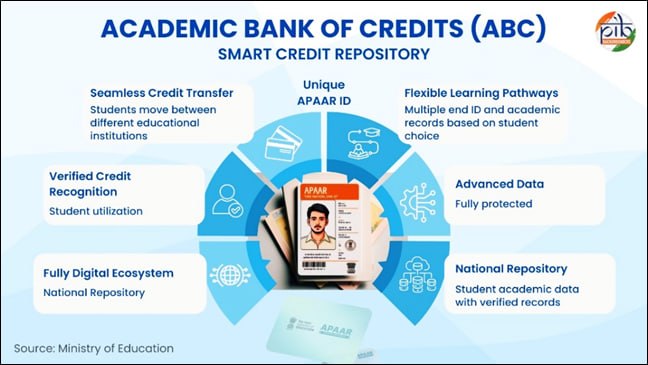
Academic Bank of Credits (ABC) & APAAR
The Academic Bank of Credits (ABC) is a UGC-regulated digital repository that enables students to store, transfer, and redeem academic credits across recognised institutions. APAAR provides a lifelong 12-digit digital student ID linked to Aadhaar, DigiLocker, and ABC. Introduced under NEP 2020, these reforms promote flexible learning, student mobility, secure digital records, and seamless credit recognition while supporting lifelong education.