This matter is related to:
Enlargement of the number of seats of the Lok Sabha.
Women Reservation Bill.
Balance of power among the states.
The principle of “One Man, One Value.”
Gerrymandering by constituency boundaries.
Possibility of completing the process of delimitation before 2029 Lok Sabha Elections.
Background
What is Delimitation?
Delimitation means the fixing or redrawing of boundaries of territorial constituencies for elections to ensure broadly equal representation based on population.
The exercise has two distinct dimensions:
Allocation of seats among States/UTs based on population.
Redrawing of individual constituencies within each State/UT.
Constitutional Basis
Provision | Significance Significance |
Article 81 | Deals with composition/allocation of Lok Sabha seats among States and territorial constituencies |
Article 82 | Provides for readjustment of seats and division into territorial constituencies after each Census, subject to constitutional provisions |
Article 170 | Deals with composition and territorial constituencies of State Legislative Assemblies |
Article 330A | Provides for reservation of seats for women in Lok Sabha |
Article 332A | Provides for reservation of seats for women in State Legislative Assemblies |
Why was delimitation frozen?
The Constitution was amended to prevent States that had successfully pursued population stabilisation from being penalised through loss of parliamentary representation.
The freeze on inter-State allocation was initially associated with the 1971 Census and subsequently extended.
Therefore, the present distribution of Lok Sabha seats among States continues to substantially reflect the 1971 population ratio, even though population growth has diverged considerably across States.
Historical Background
Previous major delimitation exercises
1952 - based on 1951 Census
1962 - based on 1961 Census
1973 - based on 1971 Census
2002 Delimitation Commission - based on 2001 Census
The 2002 Commission's recommendations were implemented in 2008.
However, the 2008 exercise did not reallocate the number of Lok Sabha seats among States. It mainly redrew constituency boundaries within States.
The 2027 Census could therefore mark a major change because the population basis for inter-State seat allocation may change.
What will happen after Census 2027?
Under the existing constitutional framework, once the relevant Census data are published:
Census 2027 → Reallocation of Lok Sabha seats among States → Delimitation of constituencies → Women's reservation
A fresh delimitation does not necessarily require a new Constitutional amendment.
A Constitutional amendment would be required if the government wants to alter the existing constitutional framework, such as changing constitutional limits or rules governing the exercise.
Why is the issue controversial?
The core tension is between:
Federalism vs Democratic equality
On one side:
Federalism/population stabilisation
States that controlled population growth argue that they should not lose political representation because they successfully implemented family-planning and development policies.
On the other:
One Person, One Vote, One Value
If constituencies in one State represent substantially more voters than those in another State, the value of an individual's vote differs.
Example
A Lok Sabha MP in a relatively populous State may represent significantly more electors than an MP in a State with lower population growth.
Thus, the delimitation debate asks:
Should representation reward population size or also recognise successful population stabilisation?
This is the central constitutional and federal dilemma.
Which States could gain or lose?
Likely beneficiaries
States with high population growth are expected to gain a larger share of Lok Sabha seats, particularly:
Uttar Pradesh
Bihar
Rajasthan
Other relatively high-population States
Potentially disadvantaged
Several southern States, particularly those with relatively successful population stabilisation, could see their share of total Lok Sabha seats decline.
Potentially affected States include:
Kerala
Tamil Nadu
Andhra Pradesh
Telangana
Karnataka
Why does population-based allocation create a problem?
The constitutional principle is broadly to ensure representation according to population.
But India has experienced uneven demographic transition.
Southern States generally:
Achieved lower fertility earlier.
Stabilised population growth.
Invested significantly in health and education.
Northern States generally experienced:
Higher population growth for longer periods.
Larger increases in population.
Therefore, a strict population-based delimitation may create the perception that:
States that controlled population growth are being politically penalised, while States with higher population growth gain greater representation.
This could generate significant Centre-State tensions.
Can delimitation be completed before the 2029 elections?
Possibly, but not certain.
The previous delimitation exercise demonstrates that delimitation can take several years.
The 2002 Delimitation Commission was constituted after the 2001 Census, while its recommendations were implemented in 2008, before the 2009 Lok Sabha elections.
The 2027 Census is expected to be digitally enabled, which could potentially accelerate the process.
However, challenges include:
Census data processing.
Constitution of the Delimitation Commission.
Political negotiations.
Inter-State disagreements.
Judicial challenges.
Redrawing thousands of constituencies.
Implementation of women's reservation.
If the process is not completed before 2029, it could potentially continue during the term of the next Lok Sabha.
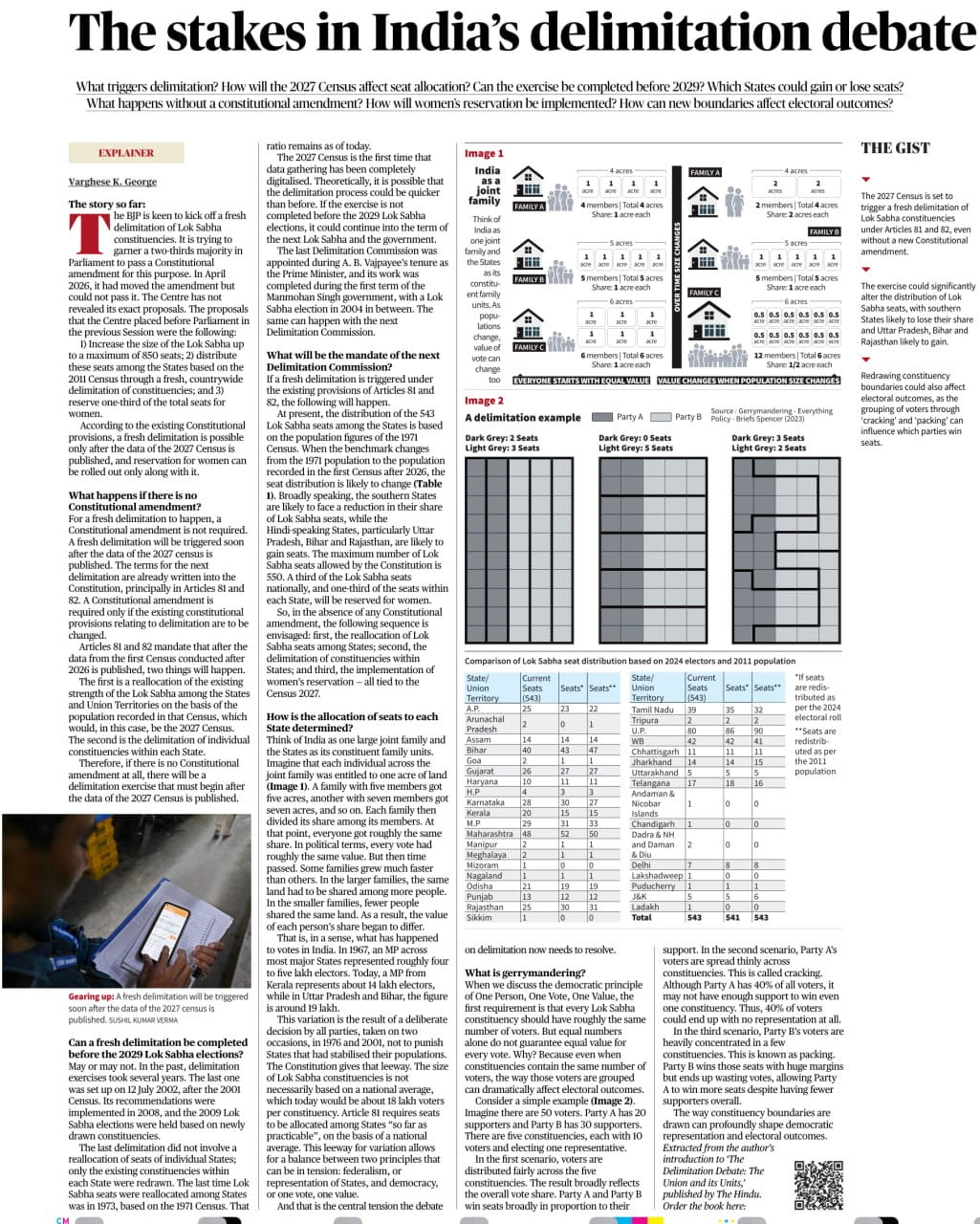
What is Gerrymandering?
Gerrymandering refers to manipulating electoral constituency boundaries to favour a particular political party or group.
Even if every constituency contains approximately the same number of voters, the way voters are geographically grouped can affect electoral outcomes.
Two important techniques
Cracking: A concentrated group of voters is divided among multiple constituencies so that they are unable to form a majority in any constituency.
Packing: A particular group of voters is concentrated into a small number of constituencies, allowing them to win those seats by very large margins while reducing their influence elsewhere.
Way Forward
Protect federal balance: The exercise should ensure that population-based representation does not unnecessarily undermine the federal character of the Constitution.
Consider increasing Lok Sabha strength. Rather than simply transferring seats from one State to another, expanding the total number of seats could help accommodate population growth while reducing the magnitude of losses for some States.
Maintain transparency: The delimitation methodology, population formula and criteria for drawing boundaries should be publicly available.
Ensure impartial delimitation: The process should be institutionally independent and protected from partisan manipulation.
Address population-stabilisation concerns. States that achieved demographic transition should not feel that their success has resulted in a disproportionate loss of political influence.
Strengthen democratic representation. The ultimate objective should be to reconcile:
Population-based representation + Federalism + Electoral fairness + Political equality
Conclusion
The process of delimitation set off by the 2027 census will be one of the most significant electoral and federal reforms undertaken in India since its independence. This is not just about revisiting the process of boundary delineation. This is more fundamentally a constitutional question: How does India guarantee "one person one vote and one value" without punishing states that have been successful at population stabilisation? It requires a balanced approach between democracy and federalism and many other factors.