Background
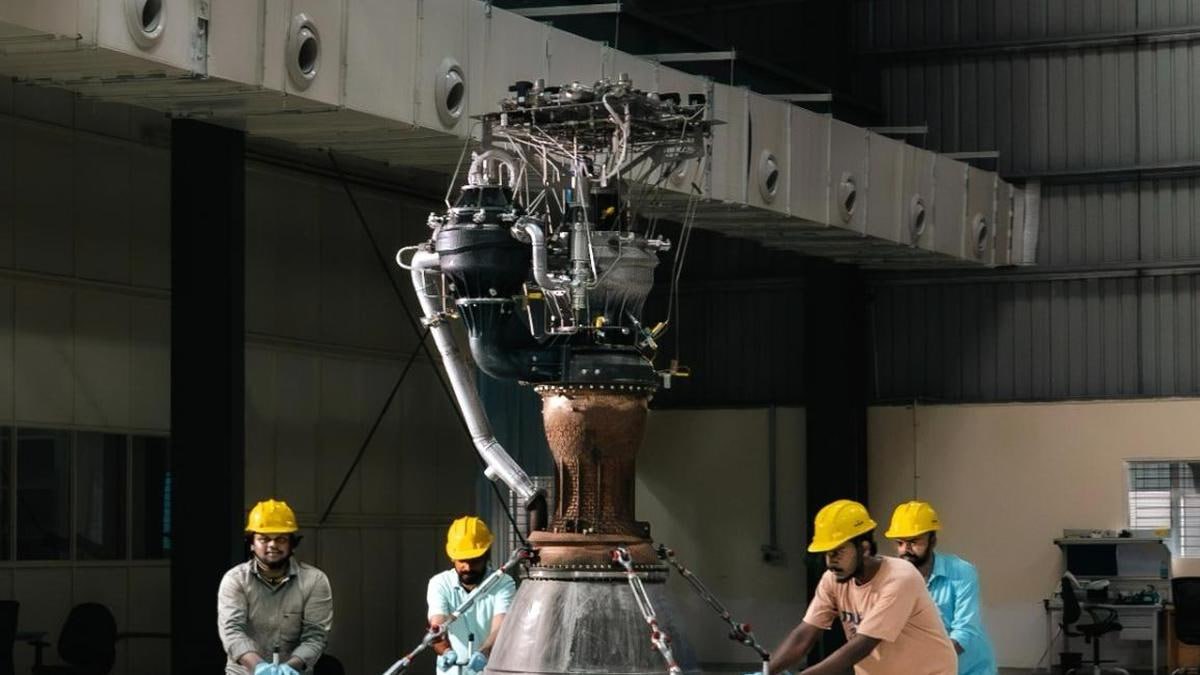
FFSC (Full-Flow Staged Combustion) is an advanced rocket-engine cycle in which both propellants pass through separate pre-burners before driving the turbopumps and entering the main combustion chamber.
It allows almost all of the propellant to contribute to thrust, resulting in high efficiency, high chamber pressure, and improved reusability.
EVEREST uses LOX (Liquid Oxygen) as oxidiser and methane as fuel.
Methane burns relatively cleanly, reducing carbon deposits and potentially enabling faster refurbishment and turnaround.
India’s private space sector expanded significantly after the 2020 space-sector reforms and the establishment of IN-SPACe.
The Indian Space Policy 2023 further enabled private companies to participate across the space value chain.
Role of IN-SPACe
IN-SPACe - Indian National Space Promotion and Authorisation Centre - is an autonomous agency under the Department of Space.
It functions as a single-window mechanism for promoting, facilitating and authorising private-sector space activities.
Its Technology Adoption Fund supports adoption and development of advanced space technologies by Indian private entities.
Features
800 kN thrust: Represents a major step towards high-thrust propulsion capability by India’s private space sector.
FFSC technology: Places India among only four countries with demonstrated FFSC development capability.
Reusable launch vehicles: High efficiency and precise throttling make FFSC engines suitable for reusable systems.
Heavy-lift potential: The technology could support reusable launch systems capable of carrying up to 30 tonnes to LEO.
Advanced manufacturing: Extensive use of 3D printing/additive manufacturing can reduce production complexity and development time.
Strategic autonomy: Indigenous propulsion technology can reduce dependence on foreign launch-engine technologies.
Private-sector innovation: Demonstrates the growing role of Indian start-ups in developing advanced space hardware.
Challenges
Technological complexity: FFSC engines involve extremely high pressures, temperatures and demanding turbomachinery requirements.
Testing and reliability: Repeated hot-fire tests are essential before the engine can be qualified for flight.
Reusability: Designing an engine for multiple flights requires high durability and rapid turnaround without compromising safety.
Manufacturing scale-up: Moving from prototypes to serial production requires sophisticated supply chains and quality-control systems.
Capital intensity: Large launch engines require substantial long-term investment.
Global competition: Indian firms face established players with extensive experience in reusable propulsion.
Regulatory and infrastructure requirements: Advanced testing facilities, certification and launch infrastructure need to grow alongside private-sector capability.
Way Forward
Strengthen public-private partnerships for propulsion research, testing and infrastructure.
Expand IN-SPACe funding and technology-transfer mechanisms for critical technologies.
Develop domestic supply chains for turbopumps, valves, sensors, combustion chambers and advanced materials.
Establish more high-capacity engine test facilities accessible to private companies.
Promote additive manufacturing and indigenous materials for faster and cheaper production.
Encourage collaboration between ISRO, start-ups, academia and industry.
Focus on reusable launch vehicles and rapid turnaround, enabling India to compete in the global commercial launch market.
Conclusion
The EVEREST FFSC LOX-Methane Engine marks a major shift in India’s space program from public sector-driven propulsion innovation to cutting-edge private sector innovation. The success of this engine will help build India’s capabilities in reusable launchers, heavy-lift launches, and space transport. Continued research, development, and cooperation among ISRO, IN-SPACe, and the private sector will be essential in turning this technological breakthrough into a launch capability.