Background
The 2015 Paris Agreement aims to keep global warming well below 2°C above pre-industrial levels while pursuing efforts to limit it to 1.5°C.
The 1.5°C figure refers to long-term average warming, not a single unusually hot year. The world experienced its first individual calendar year above 1.5°C in 2024.
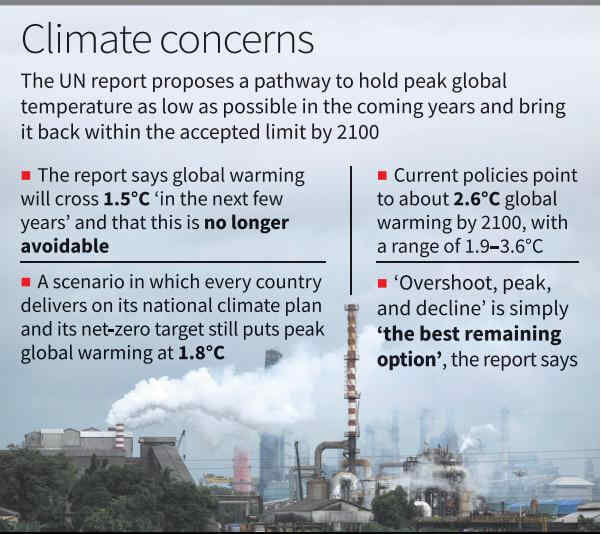
Continued greenhouse-gas emissions, particularly from coal, oil and gas, mean that crossing the long-term 1.5°C threshold is now considered increasingly unavoidable.
UNEP's new approach is called “overshoot, peak and decline”:
Temperatures temporarily exceed 1.5°C.
Warming is kept as low as possible, ideally below 2°C.
Temperatures subsequently decline through deep emissions cuts and carbon dioxide removal (CDR).
The climate eventually stabilises below 1.5°C, if technically and politically feasible.
Features
Overshoot is not surrender
Crossing 1.5°C does not mean climate action becomes pointless. Every fraction of a degree avoided reduces risks. The objective is therefore to make the overshoot as small and short-lived as possible.
Immediate mitigation
Countries need rapid and sustained reductions in: CO₂; methane; other greenhouse gases; fossil-fuel consumption
Net zero is a milestone, not the final destination if temperatures are to subsequently decline; the world would eventually need net-negative emissions.
Carbon dioxide removal
Returning below 1.5°C would require removing some CO₂ already accumulated in the atmosphere through afforestation and ecosystem restoration; bioenergy with carbon capture and storage, direct air capture; and other technological approaches
However, CDR cannot substitute for emissions reduction, and its large-scale feasibility remains uncertain.
Challenges
Irreversible impacts
Crossing 1.5°C increases the risk of irreversible tipping points, including destabilisation of major ice sheets, degradation of the Amazon and disruption of the Atlantic Meridional Overturning Circulation.
Carbon removal is uncertain
Large-scale CDR is technically difficult, expensive and potentially risky. Natural carbon sinks also have limits. Therefore, depending heavily on future carbon removal could become a dangerous excuse for delaying emissions cuts today.
Climate justice
The countries and communities most vulnerable to climate change are often those that contributed least to historical emissions. Overshoot could cause: Displacement and migration, loss of livelihoods, food insecurity, rising adaptation costs, greater inequality
This creates a major question of who pays and who bears the losses.
Risk of political complacency
There is a danger that treating overshoot as inevitable could create a “why bother?” attitude. Critics argue that the emphasis must remain firmly on rapidly reducing fossil-fuel use rather than assuming that future technologies will reverse warming.
Way Forward
Accelerate fossil-fuel transition
Rapidly expand solar, wind, storage, electrification and energy efficiency while reducing coal, oil and gas dependence.
Cut methane rapidly
Methane reduction can deliver relatively quick climate benefits because methane is a potent but shorter-lived greenhouse gas.
Strengthen carbon sinks
Protect forests, wetlands, mangroves and other ecosystems while restoring degraded landscapes.
Develop responsible CDR
Invest in carbon-removal technologies, but establish strong rules for environmental integrity, monitoring, equity and accountability.
Mainstream adaptation
Climate resilience should become part of infrastructure, agriculture, urban planning, health and disaster-management policies.
Climate finance and technology transfer
Developing and vulnerable countries need greater access to finance and technology so that mitigation and adaptation do not come at the cost of development.
Keep 1.5°C as the goal
The appropriate response to overshoot is not abandonment of the target, but reducing both the height and duration of the overshoot.
Conclusion
This UN report reflects an important shift in climate policy: the world needs to plan for a time when 1.5°C will be surpassed, but will do all it can to keep such overshoot short and to turn it around. This report is explicit about the fact that overshooting is not a haven: more and extended warming is simply riskier and entails the loss of ecosystems forever and increasingly narrow limits to adaptation.