DailyGS3GS2medium

Why Stubble Fires Keep Coming Back: Causes & Solutions

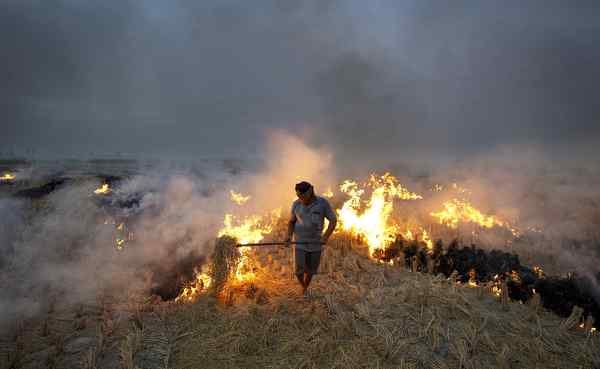
The burning of stubble continues in Punjab and Haryana because of late harvesting of paddy, a narrow window for sowing wheat, expensive machinery and low demand for straw. While the number of fires reduced by 90% from 2022-25, satellite data shows that the reduction was just 30%. Possible solutions would be diversification of crops, cheaper machinery and guaranteed prices for straw.

9 Oct 2026 4 min read 3 views
Why Stubble Fires Keep Coming Back: Causes & Solutions

Quick Revision

Why in news: According to Punjab and Haryana, there was a 90% decrease in cases of stubble burning in 2025 compared to 2022. Nevertheless, according to calculations done through various satellites, there was only a 30% decrease in the area of fires. Stubble burning is still an issue since the water conservation law has caused delays in harvesting the paddy crop, leaving farmers with no time before wheat planting.

Background: Why is stubble burning a winter problem?

  • What it is: Stubble burning involves setting fire to crop residue after harvesting, mainly paddy straw in Punjab and Haryana, which together produce around 29 million tonnes. It releases particulate matter, carbon monoxide and other harmful substances, causing smog and reducing soil fertility.

  • Old practice, new timing: Burning became prevalent in Punjab in the late 1970s and early 1980s with combine harvesters, which leave stubble behind. Its timing shifted towards winter after the Punjab Preservation of Sub-Soil Water Act, 2009.

  • Groundwater conservation: The Act prohibited paddy sowing before 10 May and transplantation before 10 June to reduce groundwater depletion and align cultivation with monsoon rainfall.

  • Narrow sowing window: Delayed transplantation pushes harvesting into late October and early November, leaving only 10–15 days to prepare fields for wheat. The long-duration PUSA-44 variety further narrows this window.

  • Economic incentives: Assured procurement at the minimum support price (MSP) and free or nearly free electricity encourage farmers to continue growing water-intensive paddy and wheat.

Features: What are the existing measures?

  • Penal measures: The National Green Tribunal ruled in 2018, and the Supreme Court upheld the view in 2023, that farmers who burn stubble could be excluded from MSP benefits.

  • Official accountability: The Commission for Air Quality Management (CAQM) has directed that complaints be filed against officials responsible for inadequate monitoring.

  • In-situ management: Crop residue is managed within the field using machines such as the Happy Seeder, Super Seeder and Rotavator, along with short-duration rice varieties and direct seeding.

  • Ex-situ management: Crop residue is removed from fields and used for alternative purposes, including bioethanol and compressed biogas production.

  • State-level approaches: Punjab has relied mainly on in-situ measures, while Haryana has also introduced financial incentives for residue management, direct seeding and crop diversification.

Has burning really fallen by 90%?

  • How fires are counted: The Consortium for Research on Agroecosystem Monitoring and Modelling from Space (CREAMS) protocol relies on MODIS and VIIRS sensors on polar-orbiting satellites.

  • Midday blind spot: These satellites pass India only from 10:30 am to 1:30 pm, and miss fires at other hours.

  • Evening shift: A November 2025 study led by Indian Space Research Organisation (ISRO) scientists, using geostationary satellite data (satellites that stay over one spot and watch all day), showed farmers have shifted burning to the evening.

Challenges

  • Economic dependence: Assured procurement and subsidised electricity discourage farmers from shifting away from paddy and wheat.

  • Costly machinery: Happy Seeders and Super Seeders require a 60-horsepower tractor, which remains underutilised for much of the year. Hiring one can cost around ₹10,000 and may involve delays.

  • Limited residue markets: Ex-situ management costs around ₹1,500–₹2,500 per acre, while markets for paddy straw remain inadequate.

  • Enforcement limitations: Excessive reliance on penalties may encourage collusion between farmers and officials, resulting in underreporting rather than genuine reductions.

  • Satellite measurement gaps: Polar-orbiting satellites observe India mainly between 10:30 a.m. and 1:30 p.m., potentially missing fires at other times.

  • Evening burning: A November 2025 study led by ISRO scientists found evidence of a shift towards evening burning, highlighting limitations in existing monitoring methods.

Way Forward

  • Integrated approach: Combine in-situ and ex-situ residue management in the short term with crop diversification away from paddy in the long term.

  • Assured straw prices: Establish a minimum price covering the costs of selling paddy straw to ex-situ industries, as recommended by a Parliamentary Committee.

  • Improve machinery access: Strengthen custom-hiring centres and ensure affordable, timely availability of crop-residue management equipment.

  • Promote crop diversification: Provide financial incentives, assured markets and remunerative prices for alternative crops.

  • Improve monitoring: Combine polar and geostationary satellite data to detect fires throughout the day and obtain more reliable estimates.

  • Balanced enforcement: Treat penalties as a last resort and prioritise farmer support, economic incentives and effective implementation.

Conclusion

Stubble burning is the result of the interplay between groundwater conservation policies, assured procurement, expensive machines and limited planting period. Any long-term solution lies in moving away from a purely punitive method of action to an incentive-based one for crop diversification, low-cost residue management and viable straw markets. The end goal must be to make it economically worthwhile for farmers to act sustainably.
UPSC Prelims Facts

Term: Why Stubble Fires Keep Coming Back

Meaning: Despite official claims of a 90% decrease in stubble-burning cases in Punjab and Haryana in 2025 compared to 2022, satellite-based estimates show only a 30% reduction in burnt area, because the Punjab Preservation of Sub-Soil Water Act 2009 delays paddy transplantation to conserve groundwater, pushing harvesting into late October–early November and leaving farmers only 10–15 days before wheat sowing—with the long-duration PUSA-44 variety and MSP-backed paddy cultivation further narrowing the window.

Related: Punjab Preservation of Sub-Soil Water Act 2009, PUSA-44, Minimum Support Price (MSP), National Green Tribunal (2018), Supreme Court (2023), Commission for Air Quality Management (CAQM), Happy Seeder, Super Seeder, Rotavator, direct seeding, bioethanol, compressed biogas, CREAMS protocol, MODIS and VIIRS sensors, ISRO geostationary satellite study (November 2025).

Core Themes: Stubble burning as a winter smog and soil-fertility problem caused by policy interplay between groundwater conservation, assured procurement and subsidised electricity; in-situ vs. ex-situ residue management; measurement gaps due to polar-orbiting satellites' midday blind spot and the shift to evening burning; challenges of economic dependence on paddy-wheat, costly machinery (~₹10,000 hiring; 60-HP tractor requirement), limited straw markets (₹1,500–2,500 per acre), enforcement limitations and underreporting; way forward through an integrated approach, assured straw prices, better machinery access, crop diversification, improved polar-plus-geostationary monitoring and balanced, incentive-based enforcement.

Prelims angle

Focus on key facts, terms and institutions mentioned above.

Mains angle

Link to relevant GS themes and frame analytical points.

Syllabus: Environment, Agriculture

Download notes

Daily Current Affairs - 09 October 2026

Free download · 1 downloads

Test yourself

Daily Current Affairs Quiz - 09 October 2026

Practice the related MCQs now.

Attempt the quiz
Free resource

Get free monthly Current Affairs PDF

Join thousands of aspirants. We'll send the compilation to your WhatsApp.

No spam. Unsubscribe anytime.

More from Current Affairs

Daily Important
EnvironmentPrelims + Mains

Tackling Food Loss and Waste: India’s Opportunity

India can cut down on food wastage through improved practices of storing, cold chain logistics, drying, transportation, processing and digitised traceability. Post-harvest studies at national levels serve as a robust evidence base, while a model like the Surat bio-CNG plant offers a glimpse into the possibilities of a circular economy. Closing the consumer-level data gap is crucial to scale up such solutions across India.

29 Sept 2026 4 min
India’s First Soil Carbon Payments to Farmers
Daily Important
EnvironmentPrelims + Mains

India’s First Soil Carbon Payments to Farmers

The first carbon payments scheme from India is called the "Aadi program" which provides ₹2.9 crore to more than 2,500 farmers in Punjab and Haryana states for using regenerative techniques such as direct-seeded rice and reduced tilling. Additional money through verified carbon credits (Verra VM0042) is being generated while saving water and reducing stubble burning.

18 Sept 2026 3 min
UN sets pathway to tackle ‘inevitable breach’ of the 1.5°C global warming limit
Daily Important
EnvironmentPrelims + Mains

UN sets pathway to tackle ‘inevitable breach’ of the 1.5°C global warming limit

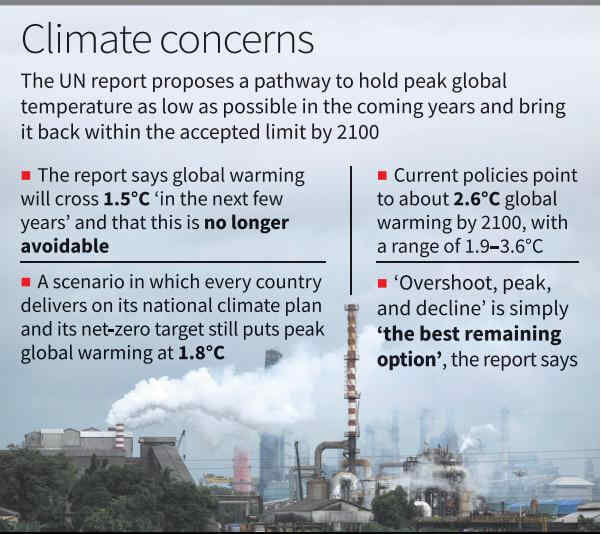
UNEP states that a breach beyond 1.5 degrees Celsius is inevitable and suggests "overshoot, peak and decline" by making deep reductions in greenhouse gas emissions and carbon dioxide removal. Issues faced: tipping points, uncertainty about carbon dioxide removal, climate justice, and complacency. Path forward: shift from fossil fuels, reduce methane, adapt, and climate finance.

3 Sept 2026 3 min