Background
Constitutional basis
The Right to Work is not explicitly a Fundamental Right under the Indian Constitution. Instead, it is included in the Directive Principles of State Policy (DPSP).
Article 41 directs the State to make effective provision for securing the right to work, subject to its economic capacity and development.
Article 39 speaks of an adequate means of livelihood and equal pay for equal work.
Article 42 calls for just and humane conditions of work.
Article 43 seeks to secure a living wage and decent standard of life.
During the Constituent Assembly debates, K.T. Shah argued for making the Right to Work a Fundamental Right. B.R. Ambedkar, while recognising its importance, considered immediate universal enforcement difficult given India's limited economic and institutional capacity.
Judicial evolution
The Supreme Court gradually strengthened the connection between livelihood and fundamental rights.
In Olga Tellis v. Bombay Municipal Corporation (1985), the Court recognised that the right to livelihood is integral to the right to life under Article 21.
In Sanjit Roy v. State of Rajasthan (1983), the Court held that payment below minimum wages in certain public employment could amount to forced labour, violating Article 23.
Features
MGNREGA
The National Rural Employment Guarantee Act, 2005, later renamed MGNREGA, converted the constitutional aspiration into a statutory employment guarantee.
Its key feature was its demand-driven character: rural households could demand employment, and the State had an obligation to provide it, subject to the Act's conditions.
Demand-driven employment: Work was to be provided when demanded.
100-day guarantee: Up to 100 days of employment per rural household.
Legal entitlement: Workers had a statutory basis to demand employment.
Decentralised implementation: Panchayats played an important role.
Social audits: Intended to promote transparency and community accountability.
Livelihood support: Provided income security during periods of rural underemployment.
However, the system faced persistent problems:
Only 100 days of employment per rural household.
Chronic underfunding.
Delayed wage payments.
MGNREGA wages often below State agricultural minimum wages.
Weak implementation and social-audit mechanisms.
In 2009, MGNREGA wages were delinked from the Minimum Wages Act, further weakening the wage guarantee.
What is the VB-GRAM G Act?
It replaced the 2005 employment guarantee law: The Viksit Bharat Guarantee for Rozgar and Ajeevika Mission (Gramin) (VB-GRAM G) Act took over from MGNREGA with effect from 1 July.
Funding is capped rather than demand-driven: The Act places an arbitrary cap on funds instead of releasing money against work actually demanded.
The wage is not tied to a minimum wage: The Act does not link its wage rate to any statutory minimum wage.
Areas can be denotified: It carries provisions to denotify specified areas and exclude them from the scheme, which ends the universality MGNREGA carried.
125 days of guaranteed employment, an increase from MGNREGA's 100 days.
Higher emphasis on productive assets: The government presents the law as linking employment with durable rural infrastructure, water security and climate resilience.
Technology-enabled governance: Includes NMMS-based attendance and face-authentication mechanisms.
Changed Centre-State financing: The new framework increases States' financial responsibility; this has been a major source of concern among States.
Revised wage rates: State-wise wage rates were notified from 1 July 2026.
Challenges
Chronic underfunding limits the actual availability of employment.
Low wages often remain below agricultural minimum wages and living-wage requirements.
Delayed wage payments weaken the effectiveness of the guarantee.
Shift from demand-driven to budget-constrained system under VB-GRAM G may weaken the Right to Work.
Greater fiscal burden on States can restrict employment generation.
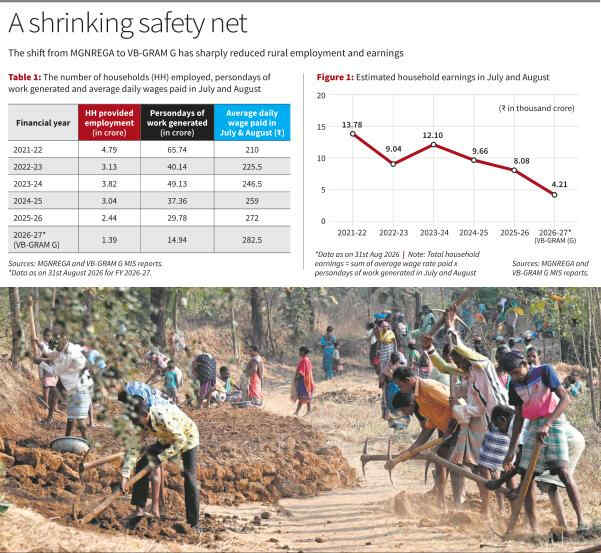
Declining employment: The article reports a 68% fall in employment in July–August 2026 compared with the previous five-year average.
Exclusion of areas through denotification can reduce universality.
Stagnant rural wages contribute to declining household earnings.
Unpaid family work among women reflects continuing rural economic vulnerability.
Weak local institutions and social audits can increase leakages and corruption.
Non-retrogression concern: Diluting an already established statutory right may conflict with the principle that progressive rights should not be deliberately rolled back.
Way Forward
Restore a genuinely demand-driven Right to Work.
Ensure adequate and demand-responsive funding instead of arbitrary expenditure ceilings.
Link wages with living wages and ensure parity with appropriate minimum-wage standards.
Guarantee timely wage payments with effective compensation for delays.
Strengthen Panchayati Raj Institutions through greater financial and administrative powers.
Make social audits independent and effective to tackle corruption.
Promote women's paid employment and reduce dependence on unpaid family work.
Treat rural employment spending as an economic investment because higher rural incomes can stimulate consumption and aggregate demand.
Protect the principle of non-retrogression so that existing social and economic rights are not weakened without strong justification.
Conclusion
Right to Work is more than just an economic right. It is a constitutional right and a right of social justice. While Article 41 makes it a directive principle of state policy, MGNREGA gave it its statutory shape. The future should lie in ensuring that the scheme is demand-driven, properly funded, tied to adequate wages and timely payments, strong Panchayats, and social audits. An employment guarantee is nothing less than a guarantee of a dignified livelihood.