Background
Submarine operations involve high risks, particularly when a submarine suffers a technical failure or accident underwater.
A submarine crew has limited oxygen and survival time; therefore, rapid rescue capability is critical.
India inducted its first Deep Submergence Rescue Vessel (DSRV) system in 2018, followed by another in 2019.
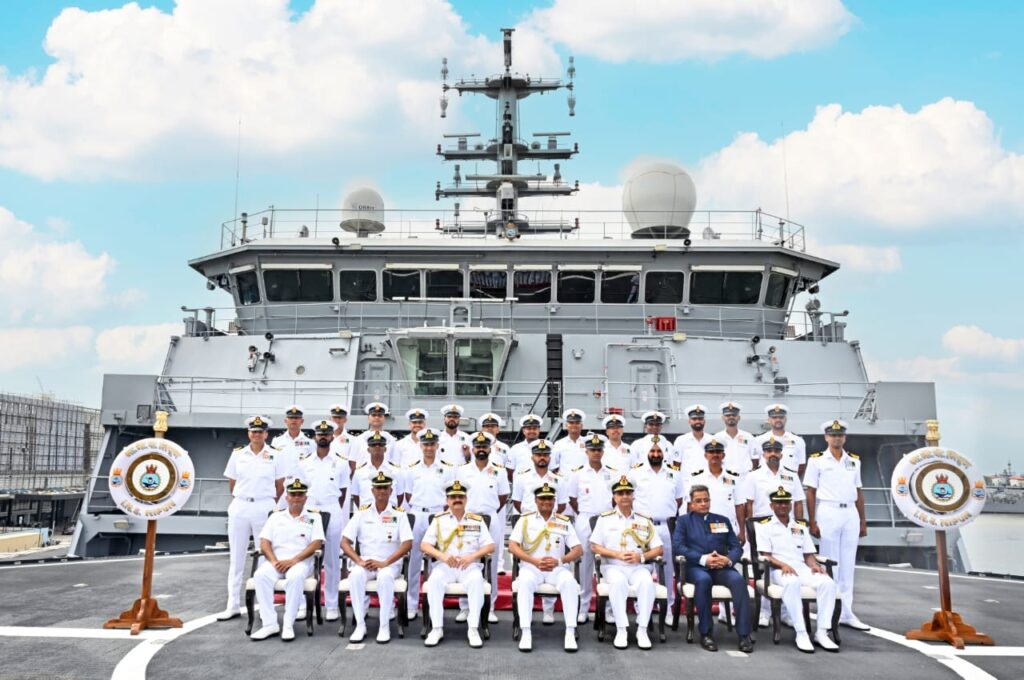
INS Nipun is the second vessel of the Nistar class and is designed to support these specialised underwater operations.
Its capability is significant not only for rescuing Indian submariners but also for assisting partner navies, strengthening India's role as a regional security provider.
Features
Dedicated underwater capability
Designed for deep-sea diving, underwater intervention, salvage and submarine rescue.
Gives the Navy a specialised platform for operations below the surface.
DSRV operations
Can embark and operate the Navy's Deep Submergence Rescue Vessel.
Enables the rescue of personnel from a disabled submarine.
Regional submarine rescue capability
Can potentially assist submarines belonging to friendly and partner countries.
Strengthens India's role as a Preferred Security Partner in the Indian Ocean Region.
Three-dimensional maritime capability
Enhances the Western Naval Command's ability to operate above, on and beneath the waves.
HADR and salvage
Diving capabilities can support underwater salvage as well as Humanitarian Assistance and Disaster Relief operations.
Indigenous shipbuilding
Designed and built by HSL, demonstrating growing domestic capability in specialised naval platforms.
Supports Atmanirbhar Bharat and reduces dependence on foreign specialised vessels.
Challenges
Limited rescue time – A disabled submarine has finite oxygen reserves, making rapid detection, deployment and rescue critical.
Geographical spread of submarine operations – India operates submarines on both the Arabian Sea and Bay of Bengal, while specialised rescue assets are limited.
Interoperability problem – DSRVs can rescue only submarines with compatible escape hatches and mating arrangements, complicating assistance to foreign navies.
Limited specialised manpower – Deep-sea and saturation diving require highly trained divers, medical teams and chamber operators, whose availability is limited.
Long shipbuilding timelines – Delays in indigenous naval construction can postpone the availability of critical capabilities.
Need for continuous training – Submarine rescue is a rare, complex operation; without regular exercises, coordination and technical proficiency can deteriorate.
Technological complexity – Effective rescue requires sophisticated DSRVs, diving systems, underwater communication, navigation and medical support, all of which need continuous upgrades.
Way Forward
Pre-position rescue capability: Ensure rapid availability on both the western and eastern seaboards.
Strengthen international cooperation: Expand submarine rescue exercises with Indian Ocean partners.
Improve interoperability: Work towards common rescue procedures, technical standards and hatch compatibility.
Build human capital: Expand specialised diving, underwater medicine and rescue training.
Leverage indigenous industry: Encourage Indian shipyards and private industry to develop advanced underwater systems.
Integrate HADR: Use underwater rescue infrastructure for maritime disasters, salvage and civilian emergencies.
Institutionalise readiness: Conduct periodic certification and full-scale rescue drills rather than treating rescue as a contingency-only capability.
Conclusion
The launch of INS Nipun is not merely an extension of the naval force but rather the development of a special underwater rescue eco-system. In a world where the maritime domain has become more contested than ever before, it is of immense importance for India's maritime security and strategic autonomy that it has the capacity to secure the submariners, support partner nations' navies, and conduct interventions in the underwater realm.