Background
What is Quantum Key Distribution?
Quantum Key Distribution (QKD) is a method of securely distributing cryptographic keys using the principles of quantum mechanics.
Unlike conventional cryptography, QKD can detect attempts to intercept the quantum communication channel because measurement of a quantum state can disturb it.
The generated quantum keys can subsequently be used for secure encryption and decryption of information.
What is Free-Space QKD?
In conventional fibre-based QKD, quantum signals travel through optical fibre.
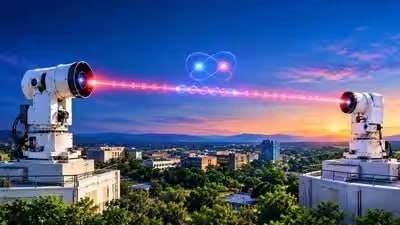
Free-space QKD transmits quantum signals through the atmosphere using optical channels.
It is particularly relevant for:
Long-distance terrestrial links
Air-to-ground communication
Ground-to-satellite links
Future satellite-based quantum communication networks.
Features
Distance: 5.56 km.
Technology: Free-space Quantum Key Distribution.
Quantum Bit Error Rate (QBER): Below 5%.
Secure key generation rate: 230–260 bits per second.
Device used: Armos, developed by QNu Labs.
Tracking technology: Pointing, Acquisition and Tracking (PAT) system.
Integration platform: Vedic Kavach, developed by BISAG-N.
The generated secure keys were successfully integrated into the encryption system.
The trial demonstrated end-to-end encryption and decryption of test messages.
How Does the System Work?
The architecture combines three important security layers:
Quantum Key Distribution
↓
Post-Quantum Cryptography
↓
Quantum Random Number Generation
QKD generates secure cryptographic keys.
Post-Quantum Cryptography (PQC) provides algorithms designed to remain secure against attacks from future quantum computers.
Quantum Random Number Generation (QRNG) provides high-quality randomness for cryptographic applications.
The integrated architecture can maintain security even if the physical quantum communication channel becomes temporarily unavailable.
Pointing, Acquisition and Tracking (PAT)
Free-space optical communication requires highly precise alignment between the transmitter and receiver.
The PAT system performs three functions:
Pointing: Directing the optical beam towards the receiver.
Acquisition: Detecting and establishing the communication link.
Tracking: Continuously maintaining alignment despite movement or atmospheric effects.
PAT is particularly important for future satellite-based quantum communication.
Institutions and Their Roles
QNu Labs
Provided the QKD technology.
Used its Armos hardware-based QKD device.
Demonstrated the generation and distribution of quantum-secure keys.
BISAG-N
Provided the field environment for the demonstration.
Integrated the QKD system with Vedic Kavach.
BISAG-N is an autonomous scientific society under the Ministry of Electronics and Information Technology (MeitY).
IIT Gandhinagar
Provided the academic and experimental environment.
Participated in the field demonstration and validation.
Importance of Collaboration
The demonstration represents collaboration among:
Industry + Government/Scientific Institution + Academia
This model can accelerate the development and deployment of indigenous quantum technologies.
Significance
Quantum-Secure Communication
QKD can help establish secure communication systems designed to address the security challenges posed by increasingly powerful computational technologies.
Protection Against Quantum Threats
Large-scale quantum computers could potentially threaten some existing public-key cryptographic systems. QKD and PQC are among the approaches being developed to address this future threat.
Foundation for Quantum Networks
A successful free-space QKD demonstration provides a technological foundation for developing longer-distance quantum communication networks.
Satellite Communication
Free-space quantum communication is particularly relevant to ground-to-satellite and satellite-to-satellite quantum links.
Indigenous Technology
The involvement of an Indian company, Indian academic institution and Indian scientific organisation demonstrates progress towards domestic quantum-security capabilities.
Hybrid Security Architecture
The combination of:QKD + PQC + QRNG
provides a layered approach rather than relying exclusively on a single security technology.
Challenges
Atmospheric Disturbances
Free-space optical signals can be affected by:
Clouds
Fog
Dust
Atmospheric turbulence
Weather conditions.
Precise Alignment
Maintaining accurate alignment over long distances requires sophisticated PAT systems.
Limited Key Generation Rate
A key generation rate of 230–260 bps remains relatively modest for applications requiring extremely high volumes of encrypted data.
Infrastructure Requirements
Large-scale quantum-secure networks require specialised optical, communication and cryptographic infrastructure.
Cost
Deployment and maintenance of quantum communication infrastructure can be expensive compared with conventional communication systems.
Standardisation and Interoperability
Widespread adoption requires common standards so that quantum-security systems developed by different organisations can work together.
Way Forward
Conduct QKD trials over longer distances.
Develop reliable ground-to-satellite quantum communication systems.
Improve key generation rates and system efficiency.
Strengthen integration between QKD and post-quantum cryptography.
Develop indigenous components for quantum communication hardware.
Establish common standards and interoperability protocols.
Expand testing under different atmospheric and geographical conditions.
Develop quantum-secure networks for defence, banking, critical infrastructure and strategic communications.
Conclusion
India’s free-space QKD demo over 5.56 km is an important milestone for the development of its own quantum-based secure communication network. The use of PQ cryptography and QRNG by it highlights a tiered strategy for future cybersecurity measures. The next objective is the transition of such field tests to larger-scale quantum communication networks.