Background
The UNSC has 15 members:
5 permanent members (P5): China, France, Russia, the UK and the US, with veto power.
10 non-permanent members, elected by the UN General Assembly.
Non-permanent members serve 2-year terms.
Elections require a two-thirds majority of members present and voting.
Seats are distributed according to equitable geographical representation.
India contests under the Asia-Pacific Group.
Five non-permanent members are elected every year.
A retiring member cannot be immediately re-elected.
Significance
Diplomatic endorsement
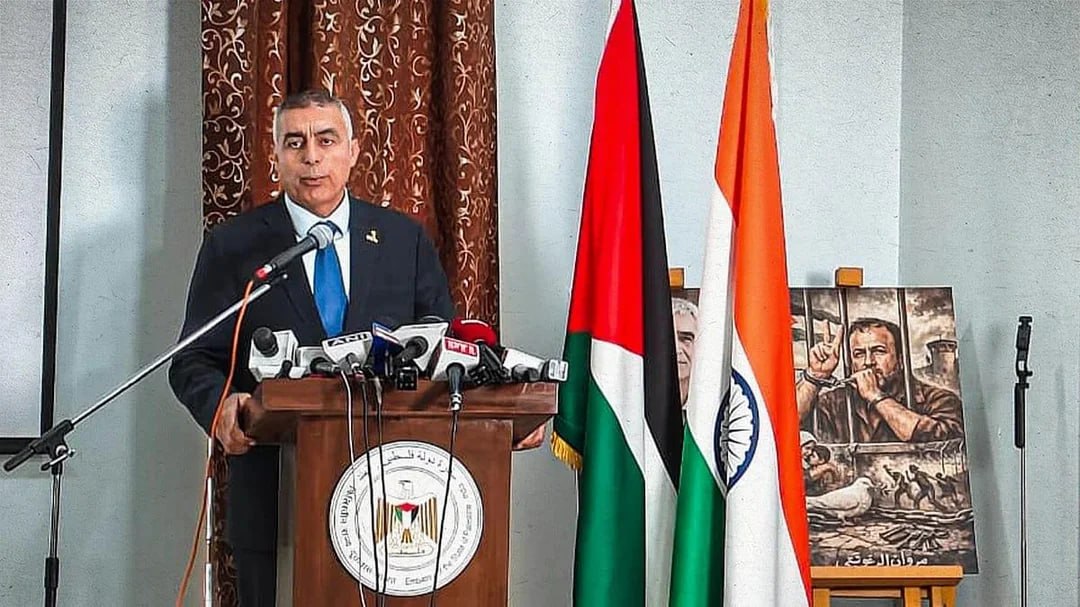
Palestine's backing strengthens India's campaign for the 2028–29 term.
Support for permanent membership
Palestine has also expressed support for India's claim to a permanent UNSC seat, aligning with India's long-standing demand for UNSC reform.
India's diplomatic balancing
Palestine expects India to leverage its relations with Israel to contribute to the Israel–Palestine peace process.
Global South diplomacy
Palestinian support can reinforce India's image as a major voice of the Global South capable of engaging with competing sides.
Humanitarian diplomacy
India's development and medical assistance demonstrate that its engagement with Palestine extends beyond political statements.
India’s Development Assistance to Palestine
West Bank: India is finalising an India-funded hospital.
Vocational training: Support for establishing a vocational training centre.
Gaza: Discussions regarding artificial limbs for amputees.
Medical equipment: Possible assistance with dialysis machines and other medical equipment, potentially routed through Jordan.
India’s Position on Palestine
India has consistently supported:
A negotiated two-state solution.
Establishment of an independent and viable Palestinian state living peacefully alongside Israel.
Humanitarian and developmental assistance for Palestinians.
A peaceful resolution based on dialogue and negotiations.
India’s De-hyphenated Israel–Palestine Policy
India follows a de-hyphenated approach, meaning its relationship with Israel and Palestine is pursued independently rather than treating them as a single diplomatic issue.
India established full diplomatic relations with Israel in 1992.
Since then, India–Israel relations have expanded significantly in areas such as defence, agriculture, technology and strategic cooperation.
At the same time, India has continued to support Palestinian statehood and provide developmental assistance.
India has also maintained its support for relevant Palestinian-related resolutions at the United Nations.
Core idea: India seeks to maintain strategic relations with Israel while preserving its historical support for Palestinian statehood.
Challenges
Balancing competing interests: India's relations with Israel and Palestine can come under pressure during periods of conflict.
Middle East instability: Escalation between Israel and Palestinian groups can constrain India's diplomatic space.
Expectations from both sides: Both Israel and Palestine may expect India to use its influence differently.
UNSC reform: Securing a non-permanent seat is achievable through elections, but India's larger objective of permanent membership requires broader international consensus and UN Charter reform.
Geopolitical competition: India's UNSC candidature competes with other countries seeking representation from the same regional grouping.
Way Forward
Continue the de-hyphenated policy while maintaining independent relations with Israel and Palestine.
Strengthen India's role as a credible dialogue partner in the Middle East.
Expand humanitarian and developmental assistance to Palestine.
Continue supporting a two-state solution based on negotiations.
Build wider support among Global South and developing countries for India's UNSC reform agenda.
Use India's growing diplomatic relations with Israel and Arab countries to contribute constructively to regional peace.
Push for comprehensive UNSC reform, including expansion of both permanent and non-permanent membership.
Conclusion
Palestinian endorsement of the Indian bid for membership of the UNSC during the period 2028-29 shows how much involvement India has had in the Palestinian struggle as well as its global standing in terms of the third world nations. The task for India is to build strategic advantage from its de-hyphenated foreign policy, being friendly to Israel on one hand and at the same time pursuing Palestinian goals and fostering peace in the Middle East region.